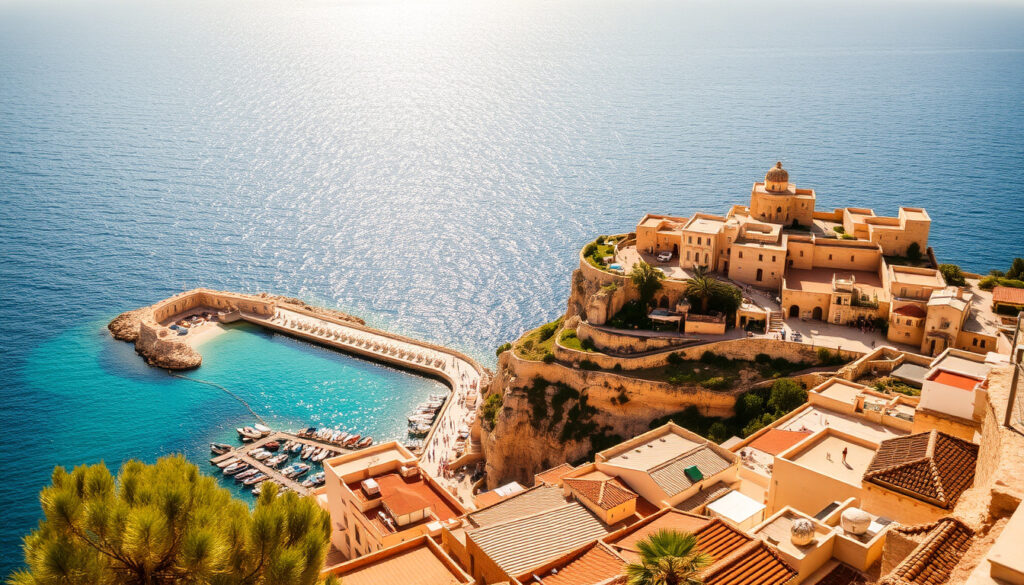
Where to Stay in Malta: Best Areas for First Timers & Couples
Picking the right base for a Malta trip forces a trade-off between sun, history, and a good night’s sleep. The island packs all three into a small area, but each neighbourhood serves a different kind of traveller.
Most popular stay area: Sliema / St. Julian’s ·
Best for beach & nightlife: St. Julian’s / Paceville ·
Best for history: Valletta (capital, UNESCO) ·
Best for families: Mellieħa / Golden Bay ·
Best for couples: Sliema ·
Minimum stay recommended: 4 days
Quick snapshot
- Valletta is a UNESCO World Heritage site and Malta’s capital city (Rough Guides travel authority)
- Sliema is connected to Valletta by a regular ferry service (Heather on Her Travels travel blog)
- Paceville in St. Julian’s is the main nightlife district with bars and clubs (Rough Guides travel authority)
- Mellieħa and Golden Bay offer the island’s best sandy beaches for families (Rough Guides travel authority)
- Exact bus route frequencies for 2025 have not been officially confirmed
- Current occupancy rates for budget hotels in peak season are subject to change
- Some areas like Mellieħa may be less walkable without a car for first-timers
- Most travellers stay 3–5 days; 4 days is recommended as sufficient for a short break (Rough Guides travel authority)
- Summer peak season (June–August) sees higher prices and crowded streets (Heather on Her Travels travel blog)
- Spring (April–May) and autumn (September–October) offer milder weather and fewer tourists (Rough Guides travel authority)
- First-time visitors without a car should prioritise Sliema or Valletta for transit access
- Families looking for seaside relaxation may prefer Mellieħa or Golden Bay
- Nightlife seekers will find Paceville in St. Julian’s the most convenient base
| Category | Best area |
|---|---|
| Top recommended area for first timers | Sliema |
| Best for history | Valletta |
| Best for nightlife | St. Julian’s (Paceville) |
| Best for beaches | Mellieħa, Golden Bay |
| Best for couples | Sliema |
| Ideal stay duration | 4 days |
Which area of Malta is the best to stay in?
Best overall for first-timers: Sliema
Sliema is widely considered the most balanced pick for anyone visiting Malta for the first time. Its central location gives you access to a regular ferry to Valletta, a wide network of bus routes, and a long seafront promenade lined with restaurants, cafes, and shops (Heather on Her Travels travel blog). Accommodation ranges from mid-range hotels to self-catering apartments, making it a practical choice for couples, small families, and solo travellers alike. The area also has solid walkability — most daily needs are within a 10-minute walk of the main strip.
The trade-off: Sliema’s popularity means it gets busy during the day, and some parts near the ferry terminal can feel crowded. But for first-timers who want a mix of convenience, dining variety, and easy access to both cultural sites and beaches, it is the strongest bet.
Sliema gives first-timers a single base that keeps Valletta, the seaside, and public transport within a short walk or ferry ride — no need to switch hotels mid-trip.
Best for history and culture: Valletta
Valletta, Malta’s UNESCO-listed capital, is the obvious choice for travellers focused on historical sites, museums, and architecture. The entire city is a fortress of baroque buildings, narrow streets, and monumental churches, and most major attractions — St. John’s Co-Cathedral, the Grandmaster’s Palace, the Upper Barrakka Gardens — are within walking distance (Rough Guides travel authority). Accommodation here is concentrated in boutique hotels and converted palazzos, giving it a unique atmosphere that Sliema cannot match.
After sunset, the city quiets down considerably. Dining options are excellent but more limited in number than in Sliema, and nightlife is virtually non-existent. Valletta works best for short, culture-heavy stays (2–3 days) rather than a full-week base for beachgoers.
Valletta’s evening calm is a plus for light sleepers but a deal-breaker for anyone who wants a lively night scene or beach access without taking a 20-minute bus ride.
Best for nightlife: St. Julian’s / Paceville
St. Julian’s, and specifically the Paceville district, is Malta’s nightlife engine. The area concentrates bars, clubs, and live-music venues into a compact zone that stays active until the early hours (Rough Guides travel authority). During the day, the seafront promenade offers beach clubs, restaurants, and a rocky coastline for swimming.
The noise level around Paceville is significant — some guest reviews on hotel booking platforms note that earplugs are necessary for rooms facing the main streets. It is less suitable for families with young children or anyone who values quiet evenings. Budget accommodation in the area is also typically pricier during summer weekends.
Best for families: Mellieħa / Golden Bay
Mellieħa, in the north of the main island, and nearby Golden Bay are the most family-friendly areas in Malta. They offer some of the island’s best sandy beaches — Mellieħa Bay is a long, shallow stretch ideal for children — and several resort hotels with kid-focused amenities such as kids’ clubs and shallow pools (Rough Guides travel authority). The pace here is relaxed, and streets are quieter than in central areas.
The drawback: public transport connections to Valletta and southern attractions require time. A bus from Mellieħa to Valletta takes about 40–50 minutes, and services can be infrequent outside peak hours. Families without a car should check bus schedules carefully before booking.
Best for couples: Sliema
For couples, Sliema edges out Valletta because of its broader dining scene, evening promenade walks, and ferry access to Mdina and St. Julian’s without needing a taxi. The area has a cosmopolitan feel that works well for romantic dinners and sunset strolls along the water (Heather on Her Travels travel blog). Many boutique hotels in Sliema offer sea-view rooms, which adds to the appeal for two-person trips.
What this means: couples who want a mix of romance and convenience without renting a car get the best of both worlds in Sliema. Those who prioritise history and quiet may still prefer Valletta, but for everyday variety, Sliema leads.
Where to avoid staying in Malta?
Areas with heavy traffic and loud nightlife
The area immediately around Paceville in St. Julian’s is the most common complaint among travellers who value sleep. The nightlife buzz spills into nearby streets, and traffic congestion during peak evening hours can make it difficult to reach accommodation by car or taxi (Rough Guides travel authority). Families and light sleepers should avoid booking within a 500-metre radius of Paceville’s main club strip.
Remote areas without good public transport
Some parts of Malta’s countryside and northern coastal villages, while scenic, have limited bus coverage. Areas like Marsaskala, Xemxija, and parts of Gozo’s interior may require a rental car for practical daily movement (Heather on Her Travels travel blog). For car-free travellers, these locations add frustration — 30-minute waits for a bus are not unusual outside the main routes.
The pattern: convenience and public-transit frequency drop sharply once you move away from the Sliema–Valletta–St. Julian’s axis. Families and couples without a car are better off staying within this triangle and taking day trips to quieter areas.
Is 4 days in Malta too long?
What you can see in 4 days
A 4-day stay is widely regarded as the sweet spot for a first visit to Malta. It allows enough time to cover Valletta’s main attractions, spend a day on the water (Comino’s Blue Lagoon or a Gozo day trip), explore Sliema’s promenade, and still have a relaxed morning or afternoon for a beach break (Rough Guides travel authority).
Suggested 4-day itinerary example
A typical pace: Day 1 arrives and settles in Sliema or Valletta; Day 2 covers Valletta’s museums and architecture; Day 3 features a boat trip to Comino’s Blue Lagoon or a visit to Mdina; Day 4 offers a relaxed morning at a beach before departure. This rhythm avoids burnout and still leaves room for spontaneity.
Should I stay in Valletta or Sliema?
Valletta: pros and cons
- Walkable historic core with world-class museums and architecture (Rough Guides travel authority)
- Quieter evenings — ideal for light sleepers and couples seeking atmosphere
- Limited dining variety compared to Sliema; nightlife is minimal
- Accommodation is more boutique and generally pricier per night
Sliema: pros and cons
- Ferry to Valletta every 20–30 minutes; excellent bus connections (Heather on Her Travels travel blog)
- Wider range of restaurants, shops, and self-catering apartments
- Active daytime vibe; some areas can be noisy
- Better base for mixing beach time with cultural visits
Five points, one pattern: Valletta wins on atmosphere and history, Sliema wins on convenience and variety. The choice depends heavily on your daily rhythm — if you plan to spend evenings out dining and walking, Sliema works better. If you prefer a tranquil base with cultural sights outside your door, Valletta is the answer.
What’s the prettiest part of Malta?
Scenic highlights: Valletta, Mdina, Marsaxlokk
Valletta’s fortified skyline and honey-coloured limestone buildings are widely photographed and admired (Rough Guides travel authority). Mdina, known as the Silent City, is a medieval walled town on a hill with narrow alleys and panoramic views over the island. Marsaxlokk, a fishing village in the south, is famous for its colourful traditional boats called luzzus and its Sunday fish market.
Coastal beauty: Gozo, Blue Lagoon, Dingli Cliffs
The Blue Lagoon on Comino offers turquoise water and white sand, though it gets crowded in peak season. Gozo’s coastline features dramatic cliffs and secluded coves. Dingli Cliffs on the main island’s west coast provide sunset views and walking paths (Heather on Her Travels travel blog).
If you are choosing a base partly for scenery, Sliema’s seafront and Valletta’s skyline give you daily beauty without leaving your neighbourhood. For a single photo-worthy day trip, Mdina and Marsaxlokk are each reachable by bus from anywhere in the Sliema–Valletta corridor.
Which is the nicest part of Malta to stay in?
For couples: Sliema
Sliema repeats as the couples’ favourite because of its long promenade, rooftop bars, and sea-view hotels. Evening walks along the water are a consistent highlight in traveller accounts (Heather on Her Travels travel blog). Valletta is a close second for couples who want a more intimate, history-rich setting.
For families: Mellieħa
Mellieħa’s sandy beaches, quieter streets, and family-oriented resorts make it the top pick for those travelling with children. The area also has a nature reserve and a small aquarium that kids typically enjoy (Rough Guides travel authority).
For nightlife: St. Julian’s
St. Julian’s, specifically the Paceville strip, is the undisputed nightlife capital. Anyone whose trip hinges on evening entertainment should stay here and accept the noise trade-off.
For budget: Sliema / St. Julian’s
Both Sliema and St. Julian’s offer a wider range of budget accommodation — hostels, guesthouses, and self-catering apartments — than Valletta, where options skew boutique and pricier.
The catch: the “nicest” area is a matter of priority. For most travellers, Sliema’s all-around balance makes it the strongest pick, but niche needs (history, quiet, nightlife, beaches) may shift the choice.
What I wish I knew before visiting Malta?
Transport tips: buses are frequent but can be crowded
Malta’s public bus network reaches most of the island, but during summer and on weekends, buses on key routes (especially route 71 from Sliema to Mdina and route 41 from Valletta to Mellieħa) can fill up quickly. Travel bloggers advise using the ferry for Valletta–Sliema crossings and saving buses for longer trips (Heather on Her Travels travel blog).
Booking accommodation in advance in peak season
Summer months (June–August) see near-full occupancy in popular areas. Booking at least 4–6 weeks ahead is standard practice for securing Sliema or Valletta hotels at reasonable rates (Rough Guides travel authority). Last-minute bookings, especially in July and August, often leave travellers paying premium prices for less convenient locations.
Currency is Euro, English widely spoken
Malta adopted the Euro in 2008, and English is one of two official languages alongside Maltese. Road signs, menus, and bus schedules are typically in both English and Maltese. This makes navigation and ordering straightforward for English-speaking travellers (Rough Guides travel authority).
English fluency lowers the stress of independent travel, but it does not solve Malta’s summer crowding or bus capacity. First-timers should still plan days around transport peaks rather than trusting that general accessibility fixes all logistics.
Related reading: Weather Playa de las Américas – Current Forecast and Best Time to Visit
Frequently asked questions
What are the safest areas to stay in Malta?
All major tourist areas — Sliema, Valletta, St. Julian’s, Mellieħa — are generally safe with low crime rates. Petty theft is rare but travellers should secure valuables on crowded buses and beaches.
Is it better to stay in Valletta or St. Julian’s?
Choose Valletta for history, culture, and quiet evenings. Choose St. Julian’s for nightlife, beach access, and a livelier atmosphere. Sliema splits the difference with good dining and transport links.
Which part of Malta has the best public transport?
Sliema and Valletta have the most frequent bus routes and the ferry connection. St. Julian’s also has strong coverage. Northern areas like Mellieħa have bus connections but with longer intervals between services (Heather on Her Travels travel blog).
Can I stay in Malta without renting a car?
Yes. Sliema, Valletta, and St. Julian’s are all walkable and served by reliable bus and ferry networks. Car-free stays are common for short trips. For family holidays in Mellieħa, a rental car adds convenience but is not essential (Rough Guides travel authority).
What is the cost of accommodation in Malta per night?
Budget guesthouses and hostels in Sliema and St. Julian’s start around €40–60 per night in shoulder season. Mid-range hotels in Valletta range €100–180 per night. Prices double during peak summer months (July–August).
Are there all-inclusive resorts in Malta?
Yes, several resorts in Mellieħa, Golden Bay, and St. Julian’s offer all-inclusive packages, especially for families. These typically cover meals, drinks, and select activities.
Which area in Malta is best for solo travelers?
Sliema tops the list for solo travellers because of its walkability, variety of restaurants, and social atmosphere. St. Julian’s is also strong for solo nightlife seekers. Valletta is quieter but safe and well-connected.
Do I need to tip in Malta hotels?
Tipping is not mandatory but is appreciated for good service. A few euros for housekeeping or 5–10% on restaurant bills is common practice in tourist areas.
For first-timers landing in Malta without a car, the choice is not about picking the single “best” area but matching a neighbourhood to your own travel rhythm. Sliema delivers the most balanced experience for couples, couples-first-timers, and anyone who wants variety at their doorstep. Valletta rewards culture-focused visitors willing to trade nightlife for atmosphere. St. Julian’s owns the night, Mellieħa owns the sand — and each comes with a clear trade-off in noise, cost, or transport time. The pattern across all profiles: book Sliema if you are unsure, then take day trips to everywhere else.
More related posts
 Woodies Lucan Opening Hours: Store Hours, Discounts & Pay
 Adam Sandler Net Worth 2025: $440M and Still Growing
 VIMOVO 500/20mg Uses, Dosage, Side Effects & Warnings
 Best Series on Netflix Ireland: Top 10, Ratings & New Shows
 Game of Thrones Season 7: Why Only 7 Episodes? Full Guide
 How to Manifest Something – Step-by-Step 369 Method Guide
 Video Chat with Strangers – Best Free Apps and Safety Tips 2025
 Audi Q2 for Sale Ireland: 2025 Prices & Guide