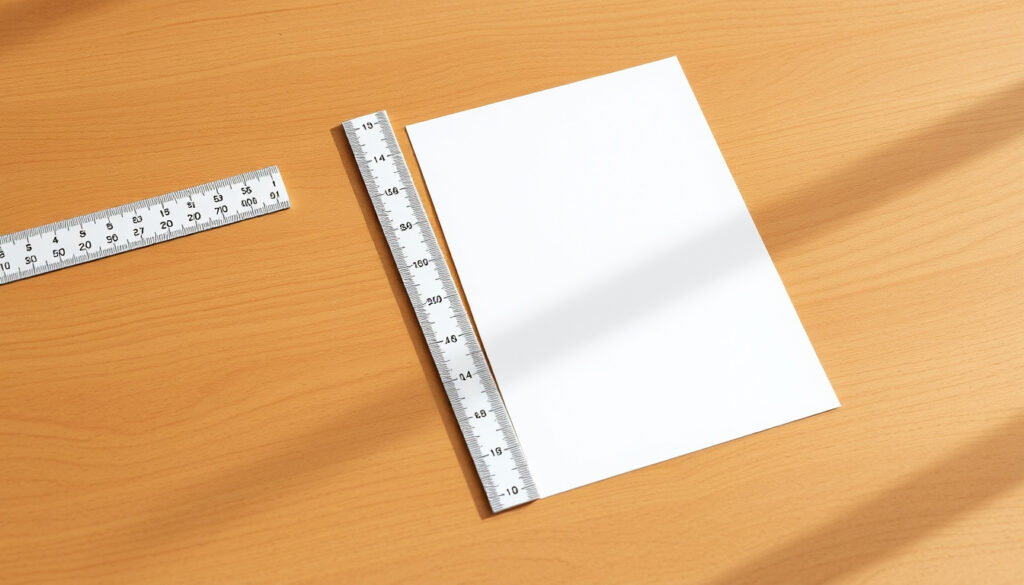
What Size is A5 Paper? Dimensions in mm, cm, Inches
If you’ve ever folded a sheet of A4 paper in half and wondered what size you just made, you were holding an A5. That simple geometric relationship—each A size is exactly half the previous one—is at the heart of an international standard that governs paper across most of the world. This article gives you the exact dimensions of A5 in millimeters, centimeters, and inches, shows how it compares to A4, A6, and the US Letter format, and explains why the proportions stay consistent no matter which size you pick.
A5 Dimensions: 148 × 210 mm · A5 in Inches: 5.8 × 8.3 in · Half of A4: Yes · ISO Standard: A-series · Common Uses: Booklets, notepads
Quick snapshot
- A5 measures 148 × 210 mm (Dimensions.com paper specs)
- Equivalent to 5.83 × 8.27 inches (Dimensions.com paper specs)
- Exactly half the area of A4 (Dimensions.com paper specs)
- Pixel dimensions depend on print resolution — common values range from 874 × 1,232 px at 150 DPI to 1,748 × 2,480 px at 300 DPI
- Tolerance allowances in ISO 216 are not published as public documentation
- The German DIN 476 standard that inspired ISO 216 originated in 1922 (Wikipedia paper sizes history)
- ISO 216 was officially established in 1975 for international adoption (Wikipedia paper sizes history)
- A5 remains the preferred format for compact printed materials in regions using ISO sizes
- Digital workflows increasingly require DPI-aware pixel conversions for print preparation
The table below consolidates the essential A5 specifications for quick reference.
| Attribute | Value |
|---|---|
| Width | 148 mm |
| Height | 210 mm |
| Inches | 5.83 × 8.27 |
| Centimeters | 14.8 × 21.0 |
| Area | 0.031 m² |
| Aspect Ratio | 1:√2 |
What size is an A5?
The A5 paper size is defined as 148 millimeters wide by 210 millimeters tall, based on the ISO 216 international standard. This size falls between the more familiar A4 and the smaller A6 in the A-series hierarchy. When converted to inches, A5 measures approximately 5.83 by 8.27 inches, which is commonly rounded to 5.8 by 8.3 inches for everyday use (Dimensions.com paper specs).
A5 in mm and cm
Because the metric system aligns naturally with the ISO standard, A5 dimensions are straightforward: 148 × 210 mm translates directly to 14.8 × 21.0 cm. All A-series sizes share the same aspect ratio of 1:√2 (approximately 1:1.414), which means that when you cut a sheet parallel to its shorter side, the resulting proportions remain identical (Wikipedia ISO paper standards).
A5 in inches
The imperial equivalent of A5 is often cited as 5.8 × 8.3 inches, though the more precise figure is 5.83 × 8.27 inches. This slight difference matters for precision work like print production, where exact measurements ensure proper alignment on press. The rounded figures are sufficient for general office use and most desktop publishing contexts (Formax Printing paper guide).
A5 in pixels
Pixel dimensions depend entirely on the output resolution. At 72 DPI (screen resolution), an A5 image measures roughly 420 × 595 pixels. At 150 DPI (draft print quality), it becomes approximately 874 × 1,232 pixels. For print-ready files at 300 DPI—the standard for commercial printing—an A5 image requires 1,748 × 2,480 pixels. At 600 DPI (high-quality offset), the dimensions jump to 3,496 × 4,960 pixels.
“The size of A5 paper is half of A4, i.e. 148 mm × 210 mm (5.8 in × 8.3 in).”
— Wikipedia, International Standard Paper Sizes
Is A5 size half of A4?
Yes, A5 is precisely half the size of A4 paper. When you cut an A4 sheet parallel to its shorter edge, you produce two A5 sheets. This is not approximate—it is a mathematical relationship baked into the ISO 216 standard. A4 measures 210 × 297 mm, and halving the 210 mm width gives you 105 mm, while halving the 297 mm height gives you 148.5 mm, which rounds to the standard 148 mm (Dimensions.com paper specs).
Exact dimensions comparison
The comparison table below shows how A4, A5, and A6 relate mathematically within the A-series.
| Format | Dimensions (mm) | Dimensions (in) | Relation |
|---|---|---|---|
| A4 | 210 × 297 | 8.27 × 11.69 | Base size |
| A5 | 148 × 210 | 5.83 × 8.27 | Half of A4 |
| A6 | 105 × 148 | 4.13 × 5.83 | Half of A5 |
The implication for designers is that scaling between A-series sizes follows a predictable ratio—A5 at 141% becomes A4, and A4 at 71% becomes A5.
Folding A4 to A5
In practice, folding an A4 sheet does not produce a perfect A5—the fold creates a slight ridge and the sheet thickens at the crease. However, the printed area of a folded A4 pamphlet often matches the A5 trim size, which is why this relationship is useful for designing brochures that will be machine-folded (Swift Publisher size guide).
The ISO halving rule means every A-series size fits perfectly into the next size up. Designers can rely on this: an A5 layout scaled to 141% produces an A4 layout, and shrinking A4 by 71% yields A5.
Which is bigger, A5 or A6?
A5 is larger than A6. A5 measures 148 × 210 mm, while A6 is 105 × 148 mm. Cutting an A5 sheet in half along its shorter side produces two A6 sheets, following the same halving logic that connects the entire A-series (Papersizes.org A-series reference).
A5 vs A6 dimensions
The A6 format is roughly the size of a standard postcard. In imperial units, A6 is approximately 4.13 × 5.83 inches, which is close to the common US postcard size of 4 × 6 inches (Avery paper comparison guide). A5 is about 2.1 times larger in area than A6, making it better suited for booklet covers, small notepads, and flyers.
“A6 is half the size of A5 paper. A5 is 148 mm × 210 mm; A6 is 105 mm × 148 mm.”
A6 from halving A5
Because each A-series size is mathematically derived from the next larger one, A6 is created by halving A5 along its shorter edge. The 148 mm width becomes 74 mm on each half (rounded to the standard 74 mm), and the 210 mm height becomes 105 mm. This consistent halving mechanism is what makes the A-series so practical for printing and binding operations (Wikipedia ISO paper standards).
What size is A4?
A4 is the most widely used paper format in the world, measuring exactly 210 × 297 mm or 8.27 × 11.69 inches. It is the standard office printing size outside North America, appearing in virtually every copy center, printer default setting, and office supply aisle in Europe, Asia, and most of Latin America (Papersizes.org A-series reference).
A4 in mm, cm, inches
The table below breaks down A4 dimensions across all three common measurement systems. For more information on paper sizes, you can check out 55 inches in cm.
| Unit | Dimensions |
|---|---|
| Millimeters | 210 × 297 mm |
| Centimeters | 21.0 × 29.7 cm |
| Inches | 8.27 × 11.69 in |
The pattern shows that all A-series dimensions scale predictably using the √2 aspect ratio, which simplifies layout scaling across formats.
A4 vs US Letter
US Letter, the standard format in North America, measures 216 × 279 mm (8.5 × 11 inches). This means US Letter is slightly wider but shorter than A4. The difference is small—about 6 mm narrower and 18 mm shorter—but it is enough to cause document formatting problems when switching between regions. A4’s narrower profile and longer length come from its √2 aspect ratio, which US Letter does not share (Wikipedia ISO paper standards).
If you design a document in A4 and someone in the US prints it on Letter, expect slight margins and potential cropping. Conversely, a Letter document printed on A4 will have extra white space on the top and bottom.
Professionals exchanging documents internationally should verify paper settings before printing to avoid waste and rework.
A1, A2, A3, A4 paper sizes
The A-series extends well beyond A4 and A5, reaching sizes used for architectural drawings, posters, and large-format printing. The series starts at A0, which has an area of exactly 1 square meter (841 × 1,189 mm), and each subsequent size halves the previous one.
Full A-series progression
The table below shows all A-series sizes from A0 to A6 with their dimensions and typical applications.
| Size | Dimensions (mm) | Dimensions (in) | Typical use |
|---|---|---|---|
| A0 | 841 × 1,189 | 33.1 × 46.8 | Large technical drawings |
| A1 | 594 × 841 | 23.4 × 33.1 | Architectural plans |
| A2 | 420 × 594 | 16.5 × 23.4 | Flip charts, posters |
| A3 | 297 × 420 | 11.7 × 16.5 | Large documents, tabloid |
| A4 | 210 × 297 | 8.27 × 11.69 | Office printing |
| A5 | 148 × 210 | 5.83 × 8.27 | Booklets, notepads |
| A6 | 105 × 148 | 4.13 × 5.83 | Postcards, pocket notes |
The catch for users selecting paper sizes is that each halving step also halves the area, so A3 is not simply a smaller A4—it contains exactly four times less surface area.
Common uses by size
- A0–A1: Engineering blueprints, GIS maps, large event posters
- A2–A3: Architectural presentations, art prints, newspaper prototypes
- A4: Business correspondence, reports, standard printing
- A5: Pocket notebooks, promotional flyers, program booklets
- A6: Postcards, thank-you cards, appointment reminders
Summary
A5 paper is 148 × 210 mm (5.83 × 8.27 in), exactly half the area of A4, and a practical middle ground between full-size office paper and small postcard formats. The ISO 216 standard that defines these dimensions ensures consistency across every country that uses the A-series, which is most of the world outside North America. For anyone designing printed materials—whether for international distribution or local markets—the A5 size offers a compact format that fits standard envelope inserts and copiers while providing enough space for readable content. Printers in North America can accommodate A5, though US Letter remains the default; switching to A5 in your printer settings unlocks a format that many international partners and customers expect as the norm.
Businesses targeting global markets should consider adopting A5 as a standard format for brochures and product sheets, reducing the need for region-specific reprints.
Related reading: Countries in North America · Countries in the EU
Frequently asked questions
What size is A5 in pixels?
Pixel dimensions vary with resolution. At 300 DPI (print standard), A5 is 1,748 × 2,480 pixels. At 150 DPI, it is approximately 874 × 1,232 pixels. Always match your DPI to your intended output format.
What size is A3 in cm?
A3 measures 29.7 × 42.0 cm, making it 4 times the area of A5 and twice the area of A4.
How does A5 compare to US Letter?
A5 is narrower (148 mm vs 216 mm) but taller (210 mm vs 279 mm for US Letter’s height) when measured in metric. In imperial units, A5 is 5.83 × 8.27 inches versus US Letter at 8.5 × 11 inches. US Letter is wider but A5 is closer in total area.
What are common A5 uses?
A5 is popular for pocket notebooks, journal refills, promotional brochures, event programs, and compact product catalogs. Its portability makes it a preferred format for takeaway menus and instructional leaflets.
Is A5 standard worldwide?
A5 is standard in all countries using ISO 216, which includes most of Europe, Asia, Africa, and South America. North America primarily uses US Letter and does not commonly stock A5 paper in retail stores.
What size is A1 paper?
A1 measures 594 × 841 mm (23.4 × 33.1 inches). It is commonly used for architectural drawings, large presentation posters, and technical plans.
Can A5 fit in A4 printers?
Yes. Most modern printers that handle A4 can accept A5 through the manual feed slot or by selecting “A5” in the paper size settings. The smaller sheet fits cleanly without trimming or jamming.
More related posts
 BYD Seal U Price Ireland – Trims, Specs, Availability
 Palm Beach Takeaway Closure: Ballybrack Chipper Status
 Mary Lou McDonald Sister: Trans Sibling and Family Details
 Eid ul Adha 2025: Confirmed Dates and Key Facts
 Kpop Demon Hunters Songs – Full Tracklist and Artists
 Leeds United vs West Ham Lineups: Confirmed & Predicted XI
 Houses for Sale in Castleknock: 2025 Guide to Prices & Agents
 Birmingham Airport to City Centre: Best Ways (2025)