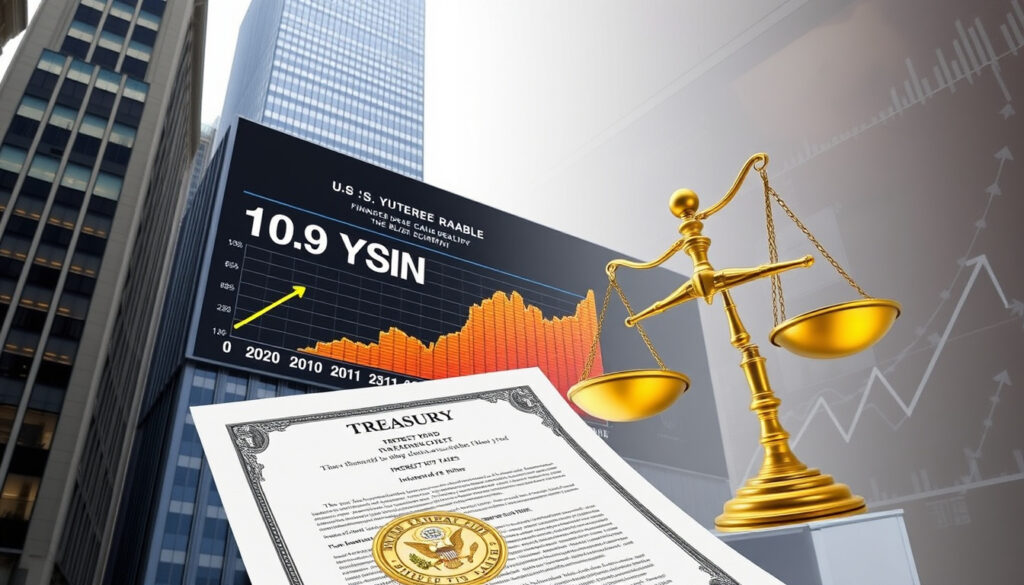
US 10-Year Bond Yield: Current Rate, Meaning & Why It Moves
Few numbers get checked as often as the U.S. 10-year bond yield. Traders, homeowners, and central bankers all keep an eye on it because it shows, in real time, what investors think about the economy’s direction. Right now that yield sits at 4.44%—a level that tells a story about inflation, Fed policy, and the global demand for safety. By the end of this page you’ll know what that number means, why it moves, and how it affects your own finances.
Current U.S. 10-Year Treasury Yield: 4.44% (as of June 2, 2026) ·
Day Change: -0.01 percentage points ·
52-Week Range: 3.923% – 4.690% ·
Yield Open: 4.449% ·
Yield Day High: 4.461% ·
Yield Day Low: 4.422%
Quick snapshot
- Latest 10-year yield: 4.44% (June 2, 2026) (Trading Economics market data provider)
- 52-week low: 3.923% (FRED – Federal Reserve Bank of St. Louis official U.S. data)
- 52-week high: 4.690% (FRED – Federal Reserve Bank of St. Louis official U.S. data)
- Benchmark for mortgages, corporate bonds, and auto loans (Public.com financial education platform)
- Reflects investor confidence in economic growth (Public.com financial education platform)
- Influences Fed policy decisions (Public.com financial education platform)
- Inflation expectations (Public.com financial education platform)
- Fed interest rate changes (FRED – Federal Reserve Bank of St. Louis official U.S. data)
- Geopolitical events (Public.com financial education platform)
- Supply and demand for Treasuries (Public.com financial education platform)
- Rising yields: higher income for new bond buyers, but falling prices for existing bonds (Public.com financial education platform)
- Falling yields: lower income, but capital gains for current holders (Public.com financial education platform)
Six key facts give a quick read on where the benchmark stands right now.
| Metric | Value |
|---|---|
| Current Yield | 4.44% |
| Yield Change (Day) | -0.01% |
| Day Range | 4.422% – 4.461% |
| 52-Week Range | 3.923% – 4.690% |
| Coupon Rate | 4.375% |
| Last Updated | June 2, 2026 |
What is the current 10 year US bond yield?
The U.S. 10-year Treasury yield closed at 4.44% on June 2, 2026, according to Trading Economics market data provider. That is down about 0.02 percentage points from the previous session. A separate reading from the Federal Reserve Bank of St. Louis FRED database official U.S. data showed 4.45% on May 29, 2026—the small difference reflects the exact timing of each snapshot.
For someone checking the yield once a day, the difference between 4.44% and 4.45% is negligible. What matters is the direction: the rate has been hovering near the middle of its 52-week range after peaking at 4.69% and bottoming at 3.923%.
Where can I see the live 10-year Treasury yield?
- FRED – Federal Reserve Bank of St. Louis official U.S. data – daily values updated each business day.
- Trading Economics market data provider – live feed with intraday updates.
- Investing.com financial data platform – live chart and historical data.
How is the yield calculated?
The yield is not a single posted rate. The U.S. Treasury issues 10-year notes with a fixed coupon (the current note has a coupon rate of 4.375% FRED – Federal Reserve Bank of St. Louis). The yield you see in the market is the return an investor gets if they buy the note at its current market price. When the price goes up, the yield goes down, and vice versa. Public.com financial education platform explains that the 10-year Treasury note pays interest every six months, and the market price fluctuates with supply and demand.
A 4.44% yield does not mean every buyer earns 4.44%. If you buy a bond at a premium (above face value), your effective yield is lower than the coupon. The quoted yield is the yield to maturity for the current market price.
What does the 10 year bond yield tell us?
Think of the 10-year yield as the market’s temperature reading for the U.S. economy. Public.com financial education platform notes that a higher yield typically signals expectations of stronger growth and higher inflation. A lower yield points to weaker growth and lower inflation.
What does a 3% yield mean?
A 3% yield means an investor who buys the bond at face value will receive 3% per year in interest, paid in two semi-annual installments. If you buy the bond in the secondary market at a different price, your actual yield will differ. The 10-year note’s coupon is fixed, so the only way the yield changes is through price movement.
How is the yield used as an economic indicator?
- Mortgage rates – 30-year fixed mortgage rates often move in sync with the 10-year yield, because lenders use it as a benchmark for long-term loans (Public.com financial education platform).
- Corporate borrowing – Companies issue bonds at a spread above the 10-year Treasury; when the yield rises, corporate debt gets more expensive.
- Fed policy – The Federal Reserve watches the yield curve to gauge inflation expectations and adjust short-term rates accordingly.
The pattern: the 10-year yield acts as a bridge between the Fed’s short-term policy rate and the market’s long-term outlook. A rising yield signals that investors expect the economy to run hot; a falling yield suggests they see trouble ahead.
Why is 10 year bond yield going down?
When yields fall, bond prices are rising. That usually happens when investors buy Treasuries as a safe haven. According to FRED – Federal Reserve Bank of St. Louis official U.S. data, the 10-year yield dropped below 1% in March 2020 during the COVID-19 panic. In June 2026, the yield is trending slightly lower from its 2023 peak of 5.0%, reflecting easing inflation and steady economic growth.
What’s behind the decline in 10-year Treasury yields?
- Expectations that the Fed will cut interest rates later in 2026.
- Moderating inflation data reducing the need for higher yields.
- Geopolitical uncertainty driving money into U.S. government debt.
Does a falling yield signal a recession?
A sustained decline can be a warning. An inverted yield curve (short-term yields above long-term yields) has preceded every U.S. recession in the past 50 years. However, a modest fall like the current one (from 4.69% to 4.44%) is more consistent with a “soft landing” scenario where inflation cools without a severe downturn.
Why are US bond yields rising?
Yields rise when bond prices fall. That selling pressure usually comes from expectations of higher interest rates, stronger growth, or surging inflation. In 2021–2023, the 10-year yield climbed from about 0.9% to 5.0% as the Fed hiked rates aggressively (FRED – Federal Reserve Bank of St. Louis official U.S. data).
How do rising yields affect investors?
- Existing bondholders see the market value of their bonds fall.
- New investors get higher coupon income.
- Stock market often dips because higher yields make bonds more attractive and increase discount rates on future earnings.
What is the relationship between yields and inflation?
Public.com financial education platform states that the 10-year yield tends to rise when inflation expectations rise. That’s because investors demand a higher return to compensate for eroding purchasing power. The gap between the nominal yield and the Treasury Inflation-Protected Securities (TIPS) yield, known as the breakeven inflation rate, is a direct measure of inflation expectations.
The trade-off: rising yields punish existing fixed-income portfolios but reward savers who have been earning near-zero for years. For the broader economy, higher yields raise borrowing costs for companies and homeowners, which can slow growth.
Is it good when the 10 year yield goes down?
It depends on who you are. Lower yields are great if you already own bonds—your bonds gain value. But for retirees, pension funds, and anyone living on fixed income, lower yields mean lower interest income. Public.com financial education platform notes that in a low-yield environment, investors often have to take on more risk to generate the same income.
Is it better to have higher or lower bond yields?
There is no universal answer. The table below compares how different groups are affected.
Three groups, two scenarios: one clear pattern—winners and losers flip when the yield changes direction.
| Group | When Yields Rise | When Yields Fall |
|---|---|---|
| Existing bondholders | Portfolio value drops | Portfolio value rises |
| New income investors | Higher future income | Lower future income |
| Borrowers (mortgage, corporate) | Higher borrowing costs | Lower borrowing costs |
What does Warren Buffett say about bonds?
“Bonds are not a great investment in low-yield environments because they offer minimal real returns after inflation.”
— Warren Buffett, Berkshire Hathaway annual meetings (various years)
Buffett has long argued that in a low-yield world, equities are the better bet for long-term investors who can tolerate volatility. His stance reinforces the idea that the 10-year yield is not just a number—it’s a signal for asset allocation decisions.
What are bond yields?
A bond yield is the return an investor receives on a bond, expressed as an annual percentage. For a 10-year Treasury note, the yield combines the fixed coupon payments with any gain or loss if the bond is bought at a discount or premium. TreasuryDirect U.S. Treasury official guidance explains that marketable securities pricing varies by type, but the yield-to-maturity is the most commonly quoted figure.
What is the 10-year Treasury note, and how does it affect your finances?
- The U.S. government issues it to raise funds for spending. It has a 10-year maturity and pays a fixed coupon every six months (Public.com financial education platform).
- Its yield is the “risk-free rate” that underpins everything from mortgage rates to corporate bond yields to stock valuations.
- When the yield moves, it affects the interest you pay on a car loan or the return you earn on a savings account.
Which country has the highest bond yield?
As of early 2026, countries like Turkey, Argentina, and Egypt have 10-year government bond yields above 20%. Those high yields come with much higher risk of default or currency collapse. The U.S. 10-year yield, by contrast, is low because investors trust the U.S. government to repay its debt in full.
Timeline: Key moments in the 10-year yield
- March 2020 – Yield falls below 1% for the first time during COVID-19 panic (FRED – Federal Reserve Bank of St. Louis official U.S. data).
- January 2021 – October 2023 – Yields rise from ~0.9% to 5.0% as Fed hikes rates to combat inflation (FRED – Federal Reserve Bank of St. Louis official U.S. data).
- October 2023 – Yield peaks at 5.0%, highest since 2007.
- June 2026 – Yield trades around 4.44%, reflecting easing inflation and steady economic growth (Trading Economics market data provider).
What we know and what’s unclear
Confirmed facts
- The current 10-year yield is 4.44% (Trading Economics market data provider).
- The yield moves inversely to bond prices (Public.com financial education platform).
- The Fed’s interest rate decisions directly influence short-term yields and indirectly affect long-term yields (FRED – Federal Reserve Bank of St. Louis official U.S. data).
What’s unclear
- Whether the yield will rise or fall in the next quarter depends on upcoming inflation data and Fed signals.
- The precise long-term equilibrium level of the yield is debated among economists.
Key perspectives from the experts
“The 10-year yield is an input for our monetary policy decisions. It reflects market expectations about the economy and inflation.”
— Jerome Powell, Federal Reserve Chair (press conferences, various years)
“When yields are low, bond investors are effectively paying for the privilege of lending to the government. Over time, that destroys purchasing power.”
— Warren Buffett, Berkshire Hathaway annual meeting
“The 10-year yield is the single most important number in financial markets. It affects mortgages, corporate debt, and the stock market all at once.”
— CNBC analyst commentary, 2026
For investors in the U.S., the decision is clear: a 4.44% yield offers a positive real return if inflation stays below that level. But if inflation reaccelerates, the value of those bonds will erode. The 10-year yield remains the market’s best single barometer for where the economy is heading.
For the latest figures, check the current 10-year Treasury yield which shows a live rate of 4.31% as of late April 2026.
Frequently asked questions
Why is the 10-year Treasury yield considered the most important bond yield?
It is the most liquid and widely referenced government bond in the world. Its yield serves as the benchmark for mortgages, corporate bonds, and many other financial products. Movements in the 10-year yield ripple through the entire economy.
How does the 10-year yield affect mortgage rates?
Mortgage lenders use the 10-year yield as a base rate because mortgages are long-term loans. When the yield rises, lenders typically raise mortgage rates to maintain their profit margin. A 1% increase in the 10-year yield can push 30-year mortgage rates up by roughly the same amount.
What is the difference between the 10-year yield and the fed funds rate?
The fed funds rate is the overnight rate banks charge each other, set by the Federal Reserve. The 10-year yield is a market-determined rate for a 10-year government bond. The Fed controls short-term rates directly, but long-term rates like the 10-year yield are influenced by supply, demand, inflation expectations, and global capital flows.
Can the 10-year yield go negative?
Some countries (Germany, Japan, Switzerland) have seen negative yields on their government bonds. The U.S. 10-year yield has never gone negative, but it has come close—it briefly traded below 0.5% in 2020. A negative yield means investors are paying the government to hold their money, which usually happens during extreme fear or deflation.
How often does the yield change?
The yield changes continuously during U.S. trading hours, from the pre-market open at 8:20 AM ET to the close at 5:00 PM ET. It can also move on news overnight if global markets react. The daily change is often just a few basis points, but on major news days it can move 10–20 basis points.
What is the current 30-year Treasury yield?
The 30-year Treasury bond yield typically trades at a premium above the 10-year yield. As of June 2, 2026, the 30-year yield was approximately 4.75%–4.85%, according to FRED – Federal Reserve Bank of St. Louis official U.S. data. The spread between the two reflects the additional risk of holding a bond for three decades.
What is the 2-year Treasury yield today?
The 2-year Treasury note yield is more sensitive to Fed policy expectations. As of June 2, 2026, the 2-year yield was approximately 4.55%–4.65% (FRED – Federal Reserve Bank of St. Louis official U.S. data). The difference between the 2-year and 10-year yields (the yield curve spread) is a closely watched recession indicator.
More related posts
 How to Remove Password from PDF: Free Online Methods
 Houses for Sale in Malahide: 2025 Prices, Agents & Listings
 Ireland Weather Alert: Snow & Storm Amy from Met Éireann
 Side Effects of Mounjaro – Risks, Duration and Management Guide
 Eid ul Adha 2025: Confirmed Dates and Key Facts
 Fabrizio Romano Transfer News: Latest Updates and Done Deals
 Space NK Gift Sets – Best Luxury Picks Under $50
 Leaving Cert Results 2025: Dates, Points & Access