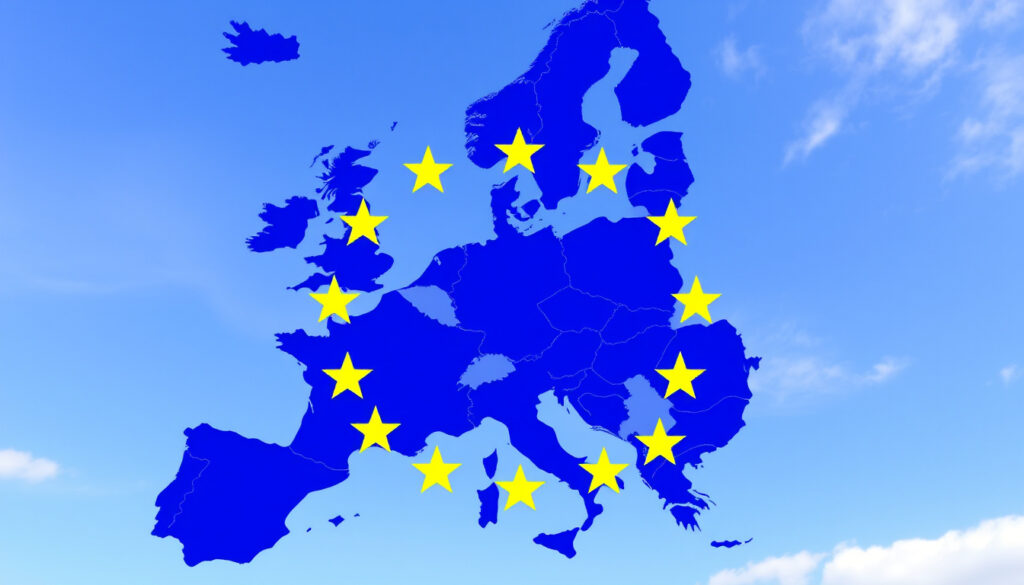
Countries in the EU: Full List of 27 Members (2024)
The European Union has held steady at 27 member states since the United Kingdom’s departure on January 31, 2020—a number that surprises many who still encounter outdated references to 25 or 28 members. Today, the bloc encompasses Austria, Belgium, Bulgaria, Croatia, Cyprus, Czechia, Denmark, Estonia, Finland, France, Germany, Greece, Hungary, Ireland, Italy, Latvia, Lithuania, Luxembourg, Malta, Netherlands, Poland, Portugal, Romania, Slovakia, Slovenia, Spain, and Sweden.
Number of EU countries: 27 · Eurozone countries: 21 · 28th member: Croatia (2013) · Europe total: 44–51
Quick snapshot
- 27 countries with full membership (European Union Official Site)
- Austria, Belgium, Bulgaria, Croatia, Cyprus, Czechia, Denmark, Estonia, Finland, France, Germany, Greece, Hungary, Ireland, Italy, Latvia, Lithuania, Luxembourg, Malta, Netherlands, Poland, Portugal, Romania, Slovakia, Slovenia, Spain, Sweden (European Union Official Site)
- EEA includes three EFTA states not in EU (Netherlands Government)
- Norway, Iceland, Liechtenstein participate; Switzerland has a separate path (Netherlands Government)
- UK left in 2020 and is now neither EU nor EEA (Netherlands Government)
- 21 Eurozone members as of 2026 (Wikipedia)
- Six EU states outside the Eurozone: Denmark, Sweden, Czechia, Hungary, Poland, Romania (Wikipedia)
- Denmark holds a treaty opt-out from the euro obligation (European Union Official Site)
- Five non-Eurozone members are contractually bound to join: Czechia, Hungary, Poland, Romania, Sweden (Wikipedia)
- Bulgaria completed its Eurozone accession on 2026-01-01 (Wikipedia)
- Ukraine and Moldova are official candidates, with accession talks ongoing (Wikipedia)
The table below outlines the verified facts that define today’s European Union, drawing from official EU records, parliamentary research, and recognized reference sources.
| Fact | Value | Source |
|---|---|---|
| EU Countries Count | 27 | European Union Official Site |
| Eurozone Countries | 21 | Wikipedia |
| 28th Member | Croatia (2013) | European Union Official Site |
| Europe Total | 44–51 | GOV.UK |
| Schengen EU Members | 25 of 27 | European Union Official Site |
| UK Exit Date | 2020-01-31 | Wikipedia |
| EP Seats Post-Brexit | 705 (initially) | EP Think Tank |
| EP 2024–2029 Term | 720 MEPs from 2024-07-16 | Wikipedia |
| Romania & Bulgaria Schengen | Air/sea borders from 2024-01-31 | IBZ Official List |
| Maastricht Treaty | 1992 convergence criteria established | European Union Official Site |
What are the 25 countries in the EU?
The EU stopped having 25 members long ago. After Croatia joined on July 1, 2013, the count became 28—and then dropped to 27 when the United Kingdom withdrew on January 31, 2020. Today, 27 sovereign states hold full membership in the European Union.
The current membership roster includes: Austria, Belgium, Bulgaria, Croatia, Cyprus, Czechia, Denmark, Estonia, Finland, France, Germany, Greece, Hungary, Ireland, Italy, Latvia, Lithuania, Luxembourg, Malta, Netherlands, Poland, Portugal, Romania, Slovakia, Slovenia, Spain, and Sweden.
Of these 27, 25 participate in the Schengen Area—the passport-free travel zone spanning most of continental Europe. Romania and Bulgaria, which joined the EU back in 2007, only gained access to Schengen for air and sea borders as of January 31, 2024, with land border controls still maintained.
The implication: despite repeated expansions throughout the 2000s and 2010s, the EU’s membership roster has now been stable for five years. Travelers, traders, and anyone following EU policy should plan around a 27-nation bloc, not the older 25 or 28 figures that still circulate online.
Current list of 27 members
The most practical way to think about EU membership is by geographic cluster rather than alphabetical order. Western and central Europe hosts the founding members—France, Germany, Belgium, the Netherlands, Luxembourg, and Italy—alongside Austria, which joined in 1995. Southern Europe contributes Spain, Portugal, Greece, Cyprus, and Malta. The northern expansion of 2004 brought in the Baltic states (Estonia, Latvia, Lithuania), the Visegrád Group (Poland, Czechia, Slovakia, Hungary), and Slovenia. Two southeastern members—Bulgaria and Romania—joined together in 2007, while Croatia entered most recently in 2013.
Shift from EU-25 to EU-27
The EU-25 era lasted just three years: from the 2004 big bang expansion until Bulgaria and Romania joined in 2007. That brief window—May 2004 to January 2007—is the only period when 25 accurately described the bloc. Anyone searching for “what are the 25 countries in the EU” is likely encountering outdated content.
Anyone still referencing EU-25 or EU-28 is working from outdated information. Today, only 27 is current.
What countries are in the EU 28?
The EU-28 designation was the bloc’s official shorthand from 2013 to 2020, covering the 27 current members plus the United Kingdom. After the UK held a 2016 referendum and formally withdrew on January 31, 2020, the European Union shrank to 27.
What few articles mention is how dramatically the exit reshuffled parliamentary representation. The UK held 73 of 751 European Parliament seats. After Brexit, those 73 seats became vacant; 27 were redistributed among 14 remaining member states. France and Spain each gained five seats, while Italy received three, the Netherlands three, and Ireland two. The remaining seats went to smaller states at one seat each. No member state lost seats in this redistribution.
The UK exit created a structural gap in the European Parliament, removing the delegation of the second-largest economy in the EU.
EU-28 historical context
The EU-28 era was historically anomalous. The UK was never a founding member—it joined the European Communities in 1973, alongside Ireland and Denmark. For nearly 47 years, it sat as a sometimes-reluctant partner, notably opting out of the euro from the currency’s launch in 1999. The UK’s 2016 referendum on EU membership produced a 52% leave vote, triggering a protracted withdrawal process that concluded on January 31, 2020.
Post-Brexit reduction to 27
Post-Brexit, the EU lost approximately 66 million citizens from its collective population—roughly the size of a large member state. The loss of the UK’s economic weight also shifted internal bargaining dynamics. France and Germany now represent a larger proportional share of EU GDP, while smaller states have gained relative influence through parliamentary seat redistributions.
The pattern: the EU functions with 27 members, but institutional memory of the 28-member era persists in pre-2020 sources and outdated search results.
Which European countries are not in the EU?
The distinction between EU membership and broader European geography trips up many readers. Europe contains roughly 44 to 51 countries depending on how one counts microstates and disputed territories—but only 27 of those belong to the European Union.
The most notable non-member is the United Kingdom, which left in 2020 and now operates independently from EU institutions. Then come the European Free Trade Association (EFTA) states: Norway, Iceland, and Liechtenstein, which participate in the EEA (European Economic Area) and thus enjoy access to the EU’s single market without full membership. Switzerland declined EEA membership entirely, maintaining bilateral agreements instead.
The Schengen Area adds another layer of complexity. Four non-EU states—Iceland, Liechtenstein, Norway, and Switzerland—participate in the passport-free zone. This means travelers can move freely between these countries and most EU members without border checks, despite their different institutional relationships with Brussels.
EEA and EFTA countries
The EEA includes all EU members plus Norway, Iceland, and Liechtenstein. These three EFTA states contribute to EU programs and follow single-market rules without holding a vote in EU institutions. For businesses, this arrangement largely mirrors full membership in daily operations—goods, services, and people flow freely. For diplomats, the distinction matters: EFTA states lack formal veto power in Council decisions.
Other European nations
Beyond the EEA, several European states have no formal relationship with the EU: the Balkan nations Serbia, Bosnia and Herzegovina, Montenegro, North Macedonia, and Albania (the last two hold candidate status), Ukraine and Moldova (candidate status granted in 2022 and 2023 respectively), Turkey (formal candidate but accession frozen), Belarus (no relationship), and microstates like Andorra, Monaco, San Marino, and Vatican City, which use the euro through bilateral agreements but hold no EU membership.
When searching “how many countries in Europe,” the answer depends entirely on whether you include microstates, transcontinental nations (Russia, Turkey, Kazakhstan), and contested territories. The EU’s 27 is a precise subset of a larger, murkier set.
Who is the 28th member of the European Union?
Croatia holds the distinction of being the 28th member of the European Union—a title that is technically historical now that the UK has departed. Croatia joined on July 1, 2013, following a referendum in which two-thirds of Croatian voters approved EU accession.
At the time, Croatia’s entry brought the EU to 28 members for the first and only time in its history. The country had undergone a decade of reform and institution-building following its 1991 independence from Yugoslavia, including EU-mandated changes to its judiciary, anti-corruption framework, and public procurement systems.
What’s less known is Croatia’s rapid progression toward euro adoption. The country joined the Eurozone on January 1, 2023—making it one of the fastest EU entrants to take up the common currency after meeting the convergence criteria. Today, Croatia ranks among the Eurozone’s 21 members.
Croatia accession details
Croatia’s path to membership followed the standard enlargement procedure: application in 2003, candidate status in 2004, accession negotiations from 2005 to 2011, and signature of the accession treaty in 2011. The two-year lag between treaty signature and formal entry (July 1, 2013) allowed Croatia to implement required reforms and for member states to ratify its entry.
Join date and impact
Croatia’s accession brought immediate institutional changes. The country received six European Parliament seats, which were drawn from the pool of 23 seats reserved for future enlargements. Its citizens gained full movement and voting rights across all EU members. Economically, Croatia integrated into the EU’s cohesion policy funding framework, receiving structural funds for regional development.
What 7 countries don’t use the euro?
Six EU member states currently operate outside the Eurozone: Denmark, Sweden, Czechia, Hungary, Poland, and Romania. Denmark holds a treaty opt-out that permanently exempts it from euro adoption—a status negotiated when it joined the EU alongside the UK in 1973. Sweden, by contrast, has no formal opt-out but has repeatedly refused to join the Eurozone, relying on a referendum result from 2003 that rejected euro adoption.
The remaining four—Czechia, Hungary, Poland, and Romania—are bound by their EU accession treaties to eventually adopt the euro. Each must meet the Maastricht convergence criteria: stable inflation rates, sustainable public finances, exchange rate stability, and long-term interest rate alignment. Progress toward meeting these criteria varies significantly among the four.
EU members outside Eurozone
Denmark’s opt-out is unique in EU law. The Danish krone operates independently, and Copenhagen successfully renegotiated its position after a 1992 referendum rejected the Maastricht Treaty, later securing a specific opt-out in the Amsterdam Treaty. The opt-out was tested again in a 2000 referendum on euro adoption, where Danes rejected joining the Eurozone by a margin of 53% to 47%.
Sweden’s situation differs legally. Unlike Denmark, Sweden has no formal treaty opt-out. The Swedish government in 2003 cited the referendum result as grounds for non-adoption, but EU law technically requires Sweden to join the Eurozone unless it formally renegotiates its position. The European Commission has never formally challenged Sweden’s non-participation, creating a de facto opt-out.
Eurozone members list
As of January 1, 2026, the Eurozone comprises 21 members: Austria, Belgium, Bulgaria, Croatia, Cyprus, Estonia, Finland, France, Germany, Greece, Ireland, Italy, Latvia, Lithuania, Luxembourg, Malta, Netherlands, Portugal, Slovakia, Slovenia, and Spain. Bulgaria’s entry on January 1, 2026, marked the most recent enlargement of the currency area. Croatia joined on January 1, 2023, after meeting convergence criteria ahead of schedule.
The Maastricht Treaty of 1992 established the convergence criteria that new entrants must satisfy. The European Central Bank and European Commission assess candidates biennially, with the most recent assessment released in June 2024. Eurozone membership is a political decision as much as a technical one, with some bound members adopting due to domestic political constraints.
Timeline signal
- — Maastricht Treaty establishes convergence criteria for euro adoption (European Union Official Site)
- — Croatia joins as 28th EU member (European Union Official Site)
- — UK exits, EU drops to 27 members (Wikipedia)
- — Croatia joins Eurozone (European Union Official Site)
- — Romania and Bulgaria join Schengen for air and sea borders (IBZ Official List)
- — European Parliament 2024–2029 term begins with 720 MEPs (Wikipedia)
- — Bulgaria joins Eurozone (European Union Official Site)
Confirmed facts
- 27 current EU members from official EU records
- UK withdrew on 2020-01-31, reducing EU to 27
- Croatia was the 28th member, joined 2013
- 21 Eurozone members as of 2026
- Bulgaria joined Eurozone on 2026-01-01
- 25 of 27 EU members in Schengen Area
- 720 MEPs in European Parliament 2024–2029 term
- France and Spain each gained +5 EP seats post-Brexit
- Denmark holds treaty opt-out from euro adoption
What’s unclear
- Exact timeline for Czechia, Hungary, Poland, or Romania to join Eurozone
- Whether Ukraine and Moldova will complete EU accession and when
- Whether Sweden will renegotiate its informal non-participation in Eurozone
- Final 2026 Eurozone composition beyond confirmed members
Related reading: Countries in North America
europarl.europa.eu, worldpopulationreview.com, en.wikipedia.org, european-union.europa.eu
The EU unites 27 members drawn from Europe countries and regions totaling around 50 sovereign states with diverse political ties.
Frequently asked questions
How many countries are in the EU?
The European Union has 27 member states. The count dropped from 28 to 27 when the United Kingdom withdrew on January 31, 2020.
What are the countries in the EEA?
The EEA includes all 27 EU members plus Norway, Iceland, and Liechtenstein—30 countries total. These three EFTA states participate in the single market without holding EU membership.
Is the UK still in the EU?
No. The United Kingdom formally withdrew from the European Union on January 31, 2020, following a 2016 referendum. It is now neither an EU nor an EEA member.
When did Croatia join the EU?
Croatia joined the European Union on July 1, 2013, becoming the 28th member. It was the last country to join before the UK’s departure reduced the count to 27.
Which EU countries use the euro?
Twenty-one EU members use the euro as their currency: Austria, Belgium, Bulgaria, Croatia, Cyprus, Estonia, Finland, France, Germany, Greece, Ireland, Italy, Latvia, Lithuania, Luxembourg, Malta, Netherlands, Portugal, Slovakia, Slovenia, and Spain. Six EU members do not use the euro: Denmark, Sweden, Czechia, Hungary, Poland, and Romania.
How many countries are in Europe?
Europe contains roughly 44 to 51 countries depending on definitions. The variation comes from how one counts microstates (Andorra, Monaco, San Marino, Vatican City, Liechtenstein), disputed territories, and transcontinental nations with territory in both Europe and Asia.
What is the difference between EU and Schengen?
The EU is a political and economic union with 27 member states. The Schengen Area is a passport-free travel zone that includes 25 EU members plus four non-EU states—Iceland, Liechtenstein, Norway, and Switzerland. Bulgaria and Romania joined Schengen for air and sea borders on January 31, 2024, but land border controls remain.
What is the richest country in Europe?
Measuring European wealth depends on the metric used. Luxembourg and Ireland typically rank highest in GDP per capita, while Germany has the largest total GDP. Richer-per-capita countries tend to be financial centers or small nations with concentrated industries.
More related posts
 Four Star Pizza Sandyford: Menu, Hours & Delivery
 Miss Scarlet and the Duke: Season 6 Guide, Cast, Streaming
 Gold Rate Today India: 22K & 24K Prices [22 June]
 Ryanair Terminal Dublin Airport: Which Terminal? (Guide)
 Petite Wedding Guest Dresses: Best Picks for Ireland
 Bitcoin Price in Dollar Today: Live BTC to USD Rate & Predictions
 Are Opticians Open During Lockdown – UK Rules Services Explained
 Hoposa Villaconcha Puerto Pollensa: Amenities, Reviews & Location