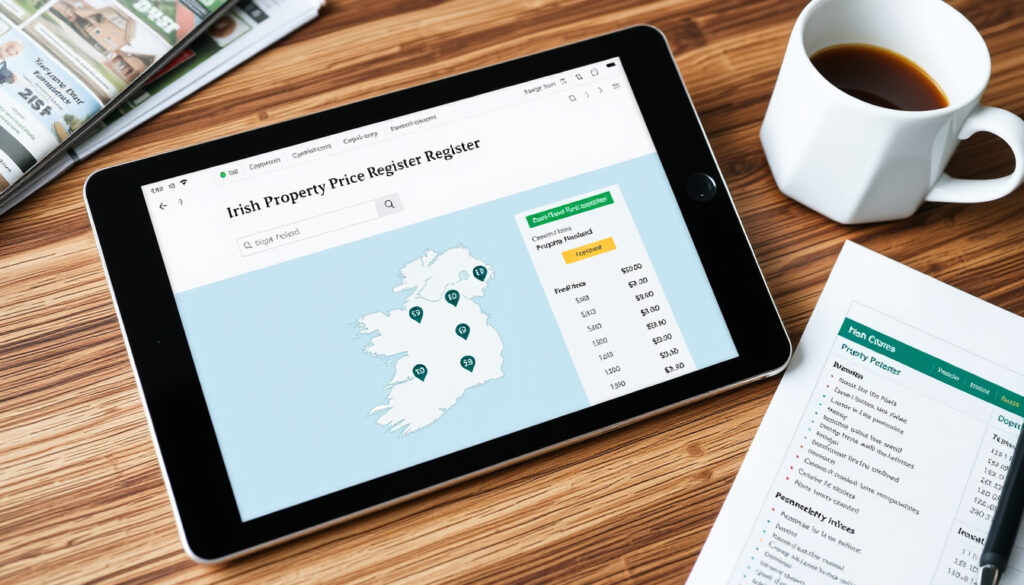
Irish Property Price Register: How to Search & Use It
Imagine you’re house hunting in Ireland and want to know what a property actually sold for — not just the asking price. The Irish Property Price Register (PPR) is the official government database that lets you check sold prices for free, going back to 1 January 2010. This guide shows you how to search it, what the data really means, and where third-party tools can help fill in the gaps.
Official start date: 1 January 2010 ·
Data types: Date of Sale, Price, Address ·
Cost: Free to access
Quick snapshot
- The official register is at propertypriceregister.ie (Residential Property Price Register (official government register))
- Data includes sales since 1 January 2010 (Residential Property Price Register search page (official site))
- Access is free and open to all (Residential Property Price Register (official government register))
- Why some sales are missing from the register (Residential Property Price Register search page (official site))
- Exact update schedule (no official confirmation) (Residential Property Price Register (official government register))
- Data starts from 1 January 2010, covering all residential sales declared to Revenue (Residential Property Price Register (official government register))
- Use the register to check recent sales in your area, then cross-reference with third-party tools for maps and trends (MyHome.ie Property Price Register (property portal))
Six key facts about the register, one pattern: the data is free and authoritative but deliberately sparse.
| Field | Value |
|---|---|
| Start date | 1 January 2010 |
| Data source | Revenue Commissioners (Stamp Duty declarations) |
| Access | Free, no registration required |
| Cost | Free |
| Update frequency | Weekly (unofficial, varies) |
| Coverage | All residential property sales in Ireland |
How do I search the Irish Property Price Register?
Navigating the official website
- Go to propertypriceregister.ie — the official portal of the Property Services Regulatory Authority (PSRA) (Irish government regulator).
- Select a year from the dropdown (2010 through 2026) and a county, then click “Perform Search” (Residential Property Price Register search page (official site)).
- No registration required — it’s completely free (Dublish guide (property blog)).
The implication: the official site is simple and fast, but you get only a table of results — no maps, no charts, no averages.
Using the search filters
- You can filter by year, county, and optionally by town or address text (Dublish guide (property blog)).
- Results show the date of sale, price, and full address of each property (Residential Property Price Register (official government register)).
- No price range or property type filter is available on the official site.
Why this matters: you’ll need to scroll through results manually if you’re looking for a specific price bracket.
Downloading the dataset
- The official site offers three options: SEARCH, DOWNLOAD SPECIFIC, and DOWNLOAD ALL (Residential Property Price Register (official government register)).
- You can download the entire dataset for a county or year as a CSV file.
- This is useful for analysts or anyone who wants to run their own calculations.
The trade-off: bulk downloads are powerful but require some spreadsheet skills to make sense of the raw data.
What data does the Property Price Register include?
Residential property sales only
- The register covers only residential properties purchased in Ireland since 1 January 2010 (Residential Property Price Register (official government register)).
- Commercial properties are not included — this is a residential-only database (Residential Property Price Register (official government register)).
- Sales are recorded from stamp duty declarations made to the Revenue Commissioners via the E-Stamping system (Gov.ie PSRA registers page (Irish government portal)).
The catch: if a property is sold without a stamp duty return (rare), it won’t appear.
Data fields shown
- Each entry includes: Date of Sale, Price, and Address (Residential Property Price Register (official government register)).
- No floor area, number of bedrooms, or property type is provided (Residential Property Price Register search page (official site)).
- The address is the full postal address as declared.
Why this matters: you’ll need to combine the register with other sources (like property listings) to get a complete picture of a home.
Why some transactions are missing
- Not all sales are published due to late filing or data errors (Residential Property Price Register search page (official site)).
- Transactions that are still within the filing window may not appear yet.
- The PSRA does not publicly guarantee a specific update frequency; updates are described as “weekly (unofficial, varies)” (Residential Property Price Register (official government register)).
The pattern: the register is the best source you have, but it’s not real-time and not perfectly complete.
Can I search for property prices near me?
Using the official site’s search by county
- On the official site, you can search by county and then by town or address text (Dublish guide (property blog)).
- There is no built-in radius search or map view (Residential Property Price Register search page (official site)).
- To find “near me,” you’ll need to manually browse results for a town and then cross-check addresses.
The implication: the official tool is functional but not user-friendly for location-based browsing.
Third-party tools with map view
- MyHome.ie offers a Property Price Register search with filters by region and locality, and displays sold prices on a map (MyHome.ie Property Price Register (property portal)).
- Daft.ie also references PSRA data within its property listings, allowing you to see sold prices alongside current listings (Daft.ie (major Irish property marketplace)).
- These tools add interactive maps, heat maps, and historical trends that the official site lacks.
Setting a radius or location filter
- Neither the official site nor most third-party tools offer a true radius search (e.g., “within 5 km of this point”).
- You can get around this by searching by town or using the map view on MyHome.ie to visually scan a neighbourhood.
- For a more analytical approach, download the full dataset for a county and filter in a spreadsheet.
Why this matters: if you’re serious about local pricing, combine the official data with a third-party map tool to save time.
What is the difference between the official register and third-party sites?
Official site: accuracy and reliability
- The official register is the only authoritative source — it’s produced by the PSRA, a government body (Residential Property Price Register (official government register)).
- Data comes directly from stamp duty declarations, so it’s legally verified.
- The official site is free, no ads, no registration (Dublish guide (property blog)).
Third-party tools: enhanced features
- Sites like MyHome.ie and Daft.ie use the same PSRA data but add analytics, maps, and price trends (MyHome.ie Property Price Register (property portal)).
- Some third-party tools, like PropertyPriceRegisterIreland.com (commercial mirror), offer additional filters such as property type and price range — but they are not official and may have outdated data.
- Third-party sites may display ads or require a paid subscription for advanced features.
When to use each
- Use the official register when you need the raw, verified sale price — for example, for legal or financial decisions.
- Use third-party tools for quick browsing, visual exploration, and spotting market trends.
- Always cross-reference: if a third-party site shows a price that seems off, check the official register.
The trade-off: official accuracy versus third-party convenience — you’ll likely need both.
How do I interpret the sale price on the register?
Understanding the listed price
- The price shown is the full sale price as declared to Revenue for stamp duty purposes (Residential Property Price Register (official government register)).
- It is the actual price paid, not the asking price — so it’s a reliable record of the transaction.
- Prices are in euros (€).
What the price does not include
- The price does not include fees, stamp duty, or renovation costs (Residential Property Price Register search page (official site)).
- It does not reflect any subsequent improvements or changes in value.
- It’s the price at the point of sale — think of it as a snapshot, not a current valuation.
Using the data for valuation
- Use multiple comparable sales from the same area and time period to estimate a property’s market value (Dublish guide (property blog)).
- Look for sales of similar properties (same approximate size, type, condition) within the last 6–12 months.
- Remember that the register only shows the price paid, not the property’s condition or features — adjust your estimate accordingly.
The pattern: the register is a starting point for valuation, not a substitute for a professional appraisal.
The official register gives you the raw numbers, but third-party tools like MyHome.ie and Daft.ie turn those numbers into maps and trends. For a complete picture, use both.
The register is only as reliable as the stamp duty declarations it’s based on. Errors do occur, and not every sale appears immediately. Always verify with a second source if the price looks unusual.
Confirmed facts and what remains unclear
Confirmed facts
- The official register is at propertypriceregister.ie (Residential Property Price Register (official government register)).
- Data includes sales since 1 January 2010 (Residential Property Price Register (official government register)).
- Access is free and open to all (Residential Property Price Register (official government register)).
- Only residential properties are included (Residential Property Price Register (official government register)).
- The register is produced by the Property Services Regulatory Authority (Gov.ie PSRA registers page (Irish government portal)).
What remains unclear
- Why some sales are missing from the register (Residential Property Price Register search page (official site)).
- Exact update schedule (no official confirmation) (Residential Property Price Register (official government register)).
- The precise number of transactions that are missing each year.
“It includes Date of Sale, Price and Address of all residential properties purchased in Ireland since the 1st January 2010, as declared to the Revenue.”
Residential Property Price Register (official government register)
“The Residential Property Price Register details sales declared to the Revenue Commissioners for stamp duty purposes via the E-Stamping system.”
Gov.ie PSRA registers page (Irish government portal)
For buyers and sellers in the Irish market, the choice is clear: use the official register for verified data, and supplement with third-party tools for convenience. Without cross-referencing, you risk missing sales that haven’t yet appeared or relying on outdated third-party information.
propertypriceregisterireland.com, data.gov.ie, irelandhouse.ie, youtube.com, ihouse.ie
Frequently asked questions
Can I access the Irish Property Price Register on a mobile device?
Yes, the official website is mobile-responsive and can be accessed from any smartphone or tablet with a web browser. No app is required.
Is there an API for the property price register?
No public API is available from the PSRA. However, the data can be downloaded in bulk as CSV files for offline analysis.
What should I do if I find an error in the register?
Contact the PSRA directly using the details on the official website: Abbey Buildings, Abbey Road, Navan, Co Meath C15 K7PY, or call 1800-252712 (Residential Property Price Register search page (official site)).
Does the register include commercial properties?
No, it covers only residential property sales. Commercial property transactions are not recorded on this register.
How do I report a missing sale?
If you believe a sale is missing, contact the PSRA. Delays can occur due to late stamp duty filings or processing errors.
Can I use the register for free?
Yes, the register is completely free to search and download. No registration or payment is required (Dublish guide (property blog)).
What is the difference between the register and the PRS (Private Residential Tenancies Board)?
The Property Price Register tracks sales prices of residential properties. The PRS (now part of the Residential Tenancies Board) records rental tenancies and rent levels. They cover different aspects of the housing market.
These answers clarify the most common uncertainties about the register, from mobile access to error reporting.
Related reading: Property for Sale in Ireland: Find Homes for Every Budget · Houses for Sale in Castleknock: 2025 Guide to Prices & Agents
More related posts
 Countries in the EU: Full List of 27 Members (2024)
 Leonardo Hotel Dublin Parnell Street: Breakfast & Rooms
 Leeds United vs West Ham Lineups: Confirmed & Predicted XI
 Best Budget Travel Backpacks: 2026 Carry-On Picks
 Dunmanway Supervalu Lotto Winner – Claims €1 Million Prize
 iPhone 17 Bill Pay Ireland: Compare Best Plans 2025
 Royal Irish Academy of Music: RIAM Exams, Rankings & Fees
 Click and Go Over 60 Holidays: Benefits & Tips