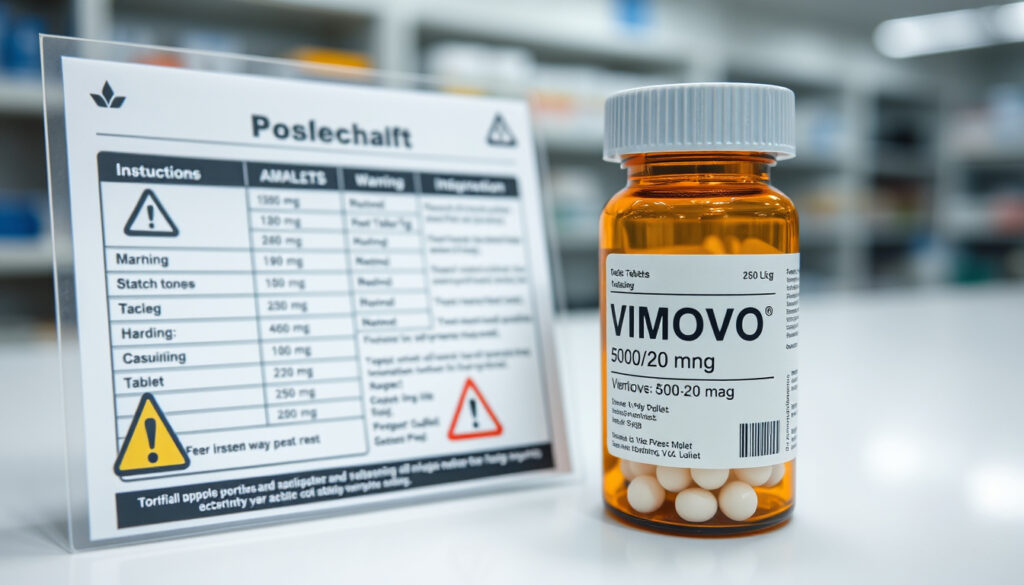
VIMOVO 500/20mg Uses, Dosage, Side Effects & Warnings
VIMOVO 500/20 mg combines naproxen and esomeprazole to treat arthritis pain while protecting your stomach. This guide explains its approved uses, dosing, side effects, and safety precautions based on official prescribing information from the U.S. FDA, the European Medicines Agency, and independent clinical research.
Active ingredients: Naproxen 500 mg + Esomeprazole 20 mg ·
Approved conditions: Osteoarthritis, rheumatoid arthritis, ankylosing spondylitis ·
Dosage form: Modified-release tablet ·
Maximum daily dose: 2 tablets (1000 mg naproxen / 40 mg esomeprazole) ·
Typical onset of relief: 1 to 2 weeks for consistent effect
Quick snapshot
- VIMOVO is approved for osteoarthritis, rheumatoid arthritis, ankylosing spondylitis (European Medicines Agency – Vimovo EPAR)
- It reduces pain and inflammation (naproxen) while protecting the stomach (esomeprazole) (U.S. FDA VIMOVO label (2014))
- Take at least 30 minutes before meals, swallow whole (Amgen VIMOVO Patient Information)
- Exact timeline of pain relief varies by individual
- Long-term safety beyond 6 months is not fully established in all populations
- No new safety signals have been issued since the last FDA label update in 2014 (U.S. FDA VIMOVO label)
- Consult your healthcare provider to determine if VIMOVO remains appropriate for your condition
Six key facts, one pattern: the same fixed‑dose combination tablet carries both an anti‑inflammatory and a stomach‑protecting agent, but its safety profile still requires careful monitoring.
| Fact | Value |
|---|---|
| Active ingredients | Naproxen 500 mg + Esomeprazole 20 mg |
| Prescription status | Prescription-only medicine |
| Approved conditions | Osteoarthritis, rheumatoid arthritis, ankylosing spondylitis |
| Dosage form | Modified-release tablet, oral |
| Common side effects | Heartburn, abdominal pain, nausea, headache |
| Manufacturer | AstraZeneca (originally), now multiple generic license holders |
What is VIMOVO 500mg 20mg used for?
Osteoarthritis relief
- VIMOVO is indicated for the symptomatic treatment of osteoarthritis in adults. It reduces joint pain and stiffness by blocking inflammatory prostaglandins via naproxen (European Medicines Agency – Vimovo EPAR).
For osteoarthritis patients who also have a history of NSAID‑related stomach issues, the built‑in esomeprazole can reduce the chance of developing duodenal ulcers compared to plain enteric‑coated naproxen (U.S. FDA VIMOVO label (2014)).
Rheumatoid arthritis management
- The U.S. label specifically includes relief of signs and symptoms of rheumatoid arthritis in adults at risk of NSAID‑associated gastric/duodenal ulcers (U.S. FDA VIMOVO label (2014)).
Ankylosing spondylitis treatment
- Patients with ankylosing spondylitis, a chronic inflammatory spinal condition, may use VIMOVO to manage pain and stiffness while benefiting from gastric protection (European Medicines Agency – Vimovo EPAR).
The implication: VIMOVO is not a general painkiller — it is reserved for chronic inflammatory conditions where the combination of NSAID and PPI reduces one of the main risks (GI ulceration) associated with long‑term anti‑inflammatory use.
How long does it take for VIMOVO 500 20mg to work?
Initial pain relief timeline
- Many patients notice a reduction in pain and inflammation within a few days of consistent twice‑daily dosing (PubMed Central clinical trial data – VIMOVO).
Full therapeutic effect after 1–2 weeks
- Maximum effect may take up to two weeks of regular use. The modified‑release formulation delivers naproxen gradually, so sustained symptom improvement builds over time (U.S. FDA VIMOVO label (2014)).
The catch: because individual metabolism and disease severity differ, your timeline may not match the average. If little change after two weeks, your doctor may need to reassess the dose or consider an alternative.
What are the side effects of taking VIMOVO?
Common side effects
- Dyspepsia (heartburn), diarrhea, abdominal pain, nausea, constipation, headache, dizziness, peripheral edema, cough, sinusitis — these were reported in at least 5% of patients in clinical trials (U.S. FDA VIMOVO label (2014)).
Serious side effects and warnings
- Serious gastrointestinal adverse events (bleeding, ulceration, perforation) can occur and may be fatal (U.S. FDA VIMOVO label – boxed warning).
- Increased risk of serious cardiovascular thrombotic events, including myocardial infarction and stroke (U.S. FDA VIMOVO label – boxed warning).
- Renal toxicity can occur; not recommended in moderate to severe renal impairment (U.S. FDA VIMOVO label (2014)).
- Long‑term PPI therapy (especially high dose) may increase risk of osteoporosis‑related fractures of hip, wrist, or spine (U.S. FDA VIMOVO label – PPI warning).
If you notice black or bloody stools, chest pain, shortness of breath, or swelling in the legs, stop taking VIMOVO and contact a doctor immediately. These could signal internal bleeding, a heart attack, or kidney trouble.
The trade‑off: VIMOVO reduces GI ulcer risk compared to naproxen alone, but it does not eliminate it — and it carries the same cardiovascular and renal risks as any NSAID.
When is the best time to take VIMOVO?
Dosing schedule
- Take one tablet twice daily, at least 30 minutes before meals. Consistent timing helps maintain steady drug levels (U.S. FDA VIMOVO label (2014)).
Chewing and crushing instructions
- Swallow the tablet whole with liquid. Do not split, chew, crush, or dissolve it — the modified‑release coating is essential for proper absorption and stomach protection (Amgen VIMOVO Patient Information).
Why this matters: taking it with food reduces the esomeprazole effect; crushing it destroys the multilayered release and can lead to a dangerous spike in naproxen levels.
Is VIMOVO a good pain killer?
Effectiveness compared to other NSAIDs
- VIMOVO is not interchangeable with immediate‑release naproxen or naproxen sodium due to its different pharmacokinetic profile. It delivers the same anti‑inflammatory power as prescription naproxen but with a lower risk of stomach ulcers (U.S. FDA VIMOVO label – comparison statement).
Suitable for back pain and inflammation
- Because it is approved for ankylosing spondylitis and osteoarthritis, VIMOVO does help inflammatory back pain. However, it is not licensed for acute non‑inflammatory back pain (European Medicines Agency – Vimovo EPAR).
The pattern: VIMOVO is a good option specifically for chronic inflammatory conditions where the stomach‑protection benefit outweighs the extra cost and complexity. For a simple headache or muscle strain, plain ibuprofen or naproxen is equally effective without the esomeprazole.
Specifications
Eight parameters, one pattern: every component is designed to maximize anti‑inflammatory effect while minimizing gastrointestinal harm.
| Specification | Details |
|---|---|
| Active ingredients | Naproxen 500 mg + Esomeprazole 20 mg |
| Dosage form | Modified‑release (delayed‑release) tablet |
| Route of administration | Oral – swallow whole |
| Approved indications | Osteoarthritis, rheumatoid arthritis, ankylosing spondylitis |
| Maximum daily dose | 2 tablets (1000 mg naproxen / 40 mg esomeprazole) |
| Prescription status | Prescription only |
| Cardiovascular risk | Boxed warning – increased risk of thrombotic events (U.S. FDA label) |
| GI risk | Boxed warning – increased risk of bleeding, ulceration, perforation (U.S. FDA label) |
| Renal caution | Not recommended in moderate to severe renal impairment (U.S. FDA label) |
| Manufacturer history | Originally AstraZeneca; now multiple license holders (GoodRx – VIMOVO overview) |
The specifications confirm that VIMOVO is tailored for chronic inflammatory conditions with built‑in stomach protection.
How to take VIMOVO correctly
Before you start
- Confirm you have risk factors for NSAID‑related stomach ulcers – that is the population VIMOVO is designed for (U.S. FDA label indication).
Daily routine
- Take the first tablet 30 minutes before breakfast and the second 30 minutes before dinner. Set a reminder if needed.
What to avoid
- Do not take other NSAIDs (ibuprofen, aspirin, diclofenac) unless your doctor approves.
- Avoid alcohol – it raises the risk of stomach bleeding.
- Talk to your doctor before combining with blood thinners or anticoagulants.
The catch: even one missed dose can allow stomach acid to increase, reducing the gastroprotective benefit. Consistency is the key to VIMOVO’s safety advantage.
Upsides and downsides
Upsides
- Significantly fewer duodenal ulcers than enteric‑coated naproxen alone (4% vs 12% in clinical trials) (U.S. FDA label data).
- Convenient fixed‑dose combination means you don’t need to remember two pills.
- Proven effective for three common inflammatory arthritis conditions.
Downsides
- Still carries all the cardiovascular and renal risks of any NSAID, plus the long‑term PPI fracture risk.
- Not interchangeable with plain naproxen – must be taken timing‑sensitive (30 min before meals).
- Treatment discontinuation due to adverse events occurred in 7% of patients in trials (PubMed Central data).
The balance of benefits and risks depends on individual patient history and monitoring.
What the evidence shows
Confirmed facts
- VIMOVO is approved for osteoarthritis, rheumatoid arthritis, ankylosing spondylitis (European Medicines Agency – Vimovo EPAR).
- It reduces pain and inflammation (naproxen) while protecting the stomach (esomeprazole) (U.S. FDA VIMOVO label).
- Take at least 30 minutes before meals, swallow whole (Amgen VIMOVO Patient Information).
What’s still unclear
- Exact timeline of pain relief varies by individual.
- Long-term safety beyond 6 months is not fully established in all populations.
These uncertainties underscore the need for regular medical review.
Perspectives from the patient information
“VIMOVO is used to reduce pain and inflammation caused by osteoarthritis, rheumatoid arthritis, and ankylosing spondylitis while helping protect the stomach from naproxen-related irritation.”
“NSAIDs can cause an increased risk of serious gastrointestinal adverse events including bleeding, ulceration, and perforation of the stomach or intestines, which can be fatal.”
The contrast is deliberate: the first speaks to the combination’s intended benefit, the second to the irreducible risk that remains.
Related reading: Side Effects of Mounjaro – Risks, Duration and Management Guide
For those seeking alternatives, the active NSAID component in VIMOVO is also available as standalone naproxen-based pain relief for managing similar arthritic conditions.
Frequently asked questions
Can I drink alcohol while taking VIMOVO?
Alcohol increases the risk of stomach bleeding from NSAIDs. It is best to limit or avoid alcohol entirely while on VIMOVO (U.S. FDA label – precaution).
What should I do if I miss a dose of VIMOVO?
Take the missed dose as soon as you remember, unless it is almost time for the next dose. Do not double up. Resume your normal schedule.
Can I take VIMOVO with ibuprofen?
No. Taking two NSAIDs together significantly raises the risk of stomach bleeding and kidney damage. Avoid all other NSAIDs while on VIMOVO (GoodRx – VIMOVO overview).
Does VIMOVO cause weight gain?
Weight gain is not a common side effect, but fluid retention (peripheral edema) occurred in some patients. Contact your doctor if you notice rapid weight gain or swelling.
Is VIMOVO safe for long-term use?
VIMOVO should be used at the lowest effective dose for the shortest possible duration. Long‑term use increases risks of cardiovascular events, kidney damage, and PPI‑related fractures (U.S. FDA label).
Can VIMOVO be taken with blood pressure medication?
NSAIDs can reduce the effectiveness of many blood pressure medicines, especially ACE inhibitors and diuretics. Your doctor may need to monitor your BP more closely (U.S. FDA label – drug interactions).
How does VIMOVO compare to other painkillers?
Unlike plain ibuprofen or naproxen, VIMOVO includes a stomach‑protecting PPI. It is not stronger than high‑dose naproxen, but it is safer for the stomach in patients at risk of ulcers (PubMed Central trial).
These answers address common concerns that patients often have when starting VIMOVO.
More related posts
 Leeds United vs West Ham Lineups: Confirmed & Predicted XI
 Don’t Look Back in Anger Chords: Easy Guitar, Piano, Ukulele Guide
 BYD Seal U Price Ireland – Trims, Specs, Availability
 Que Manger Apres Lentrainement – Complete Nutrition Guide
 Adam Sandler Net Worth 2025: $440M and Still Growing
 Shchi Soup Near Me: Find Authentic Russian Cabbage Soup in Dublin
 Carry-On 2024 Review: Is It Worth Watching on Netflix?
 2026 FIFA World Cup UEFA Qualification Schedule: Dates & Fixtures