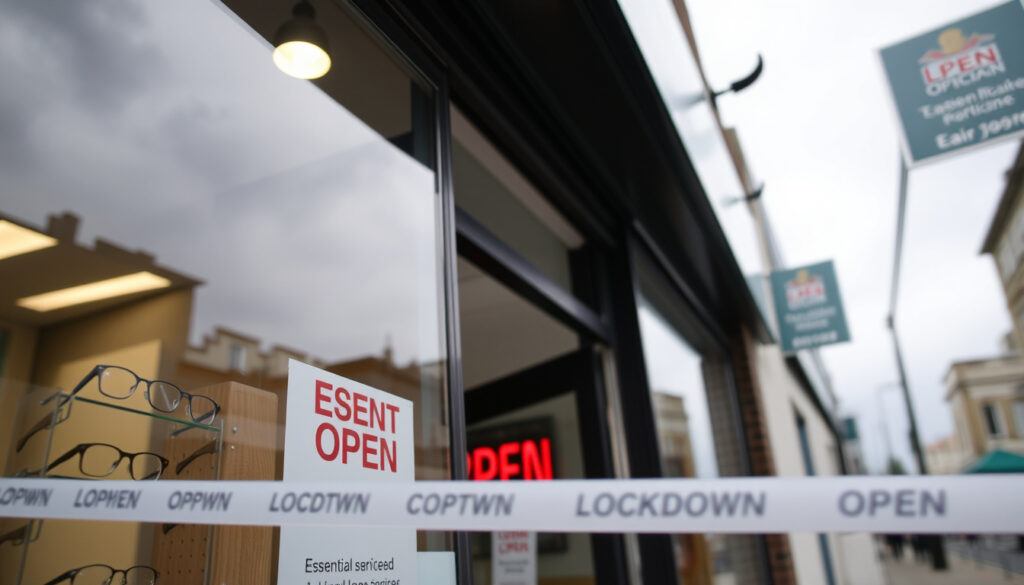
Are Opticians Open During Lockdown – UK Rules Services Explained
Throughout the COVID-19 pandemic, UK opticians remained operational as essential healthcare providers, never fully closing their doors even during the strictest lockdown periods. While routine sight tests were temporarily paused in certain phases, emergency eye care and essential appointments continued to be available across England, Scotland, Wales, and Northern Ireland. This article examines how optician services functioned during the 2020-2021 lockdowns, what care remained accessible, and how rules varied across the United Kingdom.
Eye care was classified as a public health function by government authorities, meaning optical practices operated under adapted safety protocols rather than blanket closures. Patients requiring urgent attention, those with underlying eye conditions, and individuals needing essential vision correction could still access professional services throughout the pandemic.
Are Opticians Open During Lockdown?
Opticians maintained an operational status throughout all UK lockdowns, adapting their services to prioritise emergency and essential care. The General Optical Council, College of Optometrists, and NHS England provided joint guidance that enabled practices to continue serving patients while implementing strict infection control measures. Rather than closing completely, optical professionals exercised clinical judgment to determine which services warranted immediate attention and which could be safely deferred.
The distinction between essential and routine services proved central to understanding what remained available. Emergency appointments for urgent eye conditions, essential eye tests for vulnerable patients or those with clinical necessity, and urgent spectacle or contact lens replacements continued throughout the pandemic. Routine sight tests for otherwise healthy individuals were paused during peak lockdown phases but resumed as restrictions eased.
Key Facts About Optician Operations During Lockdown
- Opticians were classified as essential healthcare services, not retail establishments
- Emergency appointments for urgent eye conditions remained available throughout all phases
- Routine sight tests were suspended during peak lockdown periods in 2020
- NHS sight tests continued for eligible patients via registered opticians
- Practices implemented enhanced hygiene protocols including PPE requirements
- Professional judgment by optometrists determined service prioritisation
- The College of Optometrists defined red and amber operational phases aligned with government restrictions
| Aspect | Full Lockdown (March-May 2020) | Summer Restrictions (2020) | Tier System (Late 2020-2021) |
|---|---|---|---|
| Operational Status | Emergency care only | Essential services resumed | Adapted delivery maintained |
| Routine Sight Tests | Suspended | Gradual resumption | Available with protocols |
| Emergency Appointments | Available | Available | Available |
| Spectacle Replacement | Urgent cases only | Essential cases | All patients with protocols |
| Contact Lens Patients | Emergency supplies | Essential supplies | Normal access with protocols |
| Children’s Eye Care | Emergency and essential | Essential appointments | Priority access maintained |
Can I Book an Eye Test or Get Eye Care During Lockdown?
During the various lockdown phases, the ability to book an eye test depended on the urgency of the need and the prevailing restrictions in each UK nation. The NHS confirmed that free sight tests remained available for eligible patients through registered opticians, though access was prioritised toward those with urgent or essential requirements. Patients were advised to contact their local practice by telephone to determine whether an appointment could be accommodated.
What Eye Care Services Remained Available?
Practices operated under a tiered system that distinguished between different categories of care. Emergency appointments addressed acute visual symptoms such as sudden vision loss, severe eye pain, flashes or floaters, and chemical injuries. Essential eye tests covered patients with existing eye conditions requiring monitoring, those who needed urgent spectacle or contact lens replacements, and children who needed vision assessments for educational purposes.
The General Optical Council instructed optometrists and dispensing opticians to use their professional judgment when determining which patients required immediate attention. Regulators committed to considering contextual factors including resource constraints and safety considerations when evaluating professional decisions made during the pandemic.
Patients seeking eye care during lockdown periods were encouraged to telephone their optician before attending. Practices conducted telephone consultations to assess urgency and scheduled appointments accordingly. Walk-in appointments were generally discouraged in favour of pre-booked slots that allowed practices to manage patient flow and maintain safety protocols.
Emergency Optician Appointments During COVID-19
The definition of an emergency appointment encompassed several specific conditions. Sudden onset of visual symptoms, including unexplained blurriness or complete vision loss, warranted immediate contact with an optician. Patients experiencing flashes of light, sudden increases in floaters, or a shadow-like curtain across their vision were advised to seek emergency care as these could indicate retinal detachment. Severe eye pain, foreign bodies, and chemical exposures also qualified for urgent same-day appointments.
Contact lens wearers experiencing urgent issues such as lost lenses causing significant discomfort, or infections requiring immediate attention, could access emergency appointments. Practices also accommodated patients whose existing spectacles had broken and who faced safety risks without functional vision correction.
Are Opticians Essential Services?
Opticians were classified as essential services throughout the COVID-19 pandemic, a designation that allowed practices to remain operational when many other retail and healthcare facilities were forced to close. This classification reflected the public health importance of maintaining access to eye care, particularly for emergency conditions that could lead to permanent vision loss if untreated.
The Rationale for Essential Status
Several factors contributed to the essential designation of optical services. Eye conditions can deteriorate rapidly without appropriate intervention, potentially causing irreversible damage to vision. Patients relying on corrective lenses face genuine safety risks when unable to see clearly, affecting their ability to drive safely, operate machinery, or navigate their environments. Additionally, opticians often serve as the first point of contact for detecting systemic health conditions such as diabetes and hypertension through routine eye examinations.
The College of Optometrists established phased operational guidance that aligned with government restriction levels. The red phase corresponded to periods of maximum restriction when only emergency and essential services could continue. The amber phase permitted expanded services as restrictions eased, while maintaining enhanced safety protocols. This framework enabled practices to adapt quickly as government guidance evolved.
Key Workers and Optician Access
While opticians were not explicitly listed among the key worker categories for childcare purposes, their essential status meant they continued working throughout lockdowns. Patients who required frequent eye care due to medical conditions, or those whose work depended on adequate vision, could access services under the essential care provisions. NHS England explicitly supported optical teams and emphasised the importance of maintaining eye care access during the pandemic response.
Optometrists and dispensing opticians operated under guidance from the General Optical Council throughout the pandemic. The regulator acknowledged that professionals might need to deviate from standard procedures due to circumstances, emphasising that decisions made in good faith during the crisis would be evaluated with appropriate context.
Opticians Lockdown Rules by Region
Health services in the United Kingdom operate under devolved administrations, meaning each nation implemented its own approach to COVID-19 restrictions while broadly aligning on the essential status of optical services. The Institute for Government noted that this devolution led to aligned but distinct rules across England, Scotland, Wales, and Northern Ireland.
England
NHS England provided direct support to optical professions throughout the pandemic, issuing specific guidance that reinforced the essential status of eye care. Following the initial scale-back in March 2020, efforts focused on clearing the backlog of delayed appointments. A letter to opticians in November 2020 praised their efforts in maintaining services during challenging circumstances. The tier system that operated in England did not result in opticians being closed, even in areas subject to Tier 3 restrictions that prohibited non-essential retail.
The Summer 2021 roadmap maintained emphasis on infection control measures, with services continuing under adapted protocols. Practices were required to implement enhanced cleaning procedures, manage patient flow, and follow guidance on personal protective equipment. These requirements remained in place until broader restrictions were lifted as the pandemic evolved.
Scotland
Scotland’s approach incorporated specific Professional Clinical Advice guidance that addressed community eye care during lockdown. The nation operated under a levels system that mirrored the College of Optometrists’ phased guidance, with practices adapting their services according to the local restriction level. Essential and emergency eye care continued throughout all phases, with the flexibility to expand routine services when conditions permitted.
The Scottish Government issued specific guidance (PCA2020(O)05) that provided detailed direction for optical practices during the pandemic response. This guidance emphasised the continuation of essential services while implementing appropriate safety measures for both patients and staff.
Wales
The Welsh Government’s Chief Optometric Advisor endorsed the judgment-based approach to care delivery that aligned with UK-wide standard operating procedures. Practices in Wales maintained essential services throughout the pandemic, with clinical discretion determining which patients required immediate attention versus those whose appointments could be safely deferred.
Welsh restrictions evolved alongside those in other nations, with optical services maintaining their essential status regardless of the specific restriction level in force. The coordination between the Welsh Government and professional bodies ensured consistent messaging and practical guidance for practitioners.
Northern Ireland
Northern Ireland’s Health and Social Care Board confirmed ongoing support for optical services throughout the pandemic lockdowns. The nation entered lockdown slightly later than Great Britain, with restrictions beginning on 28 March 2020 compared to 26 March in England, Scotland, and Wales. Despite this timing difference, the approach to optical services remained consistent with the rest of the UK.
Emergency focus remained the priority during the strictest lockdown periods, with practices adapting to provide urgent care while maintaining safety protocols. The coordination between the Health and Social Care Board and professional organisations ensured practitioners had clear guidance throughout the crisis.
A Timeline of Key Events
The pandemic response evolved significantly over the 2020-2021 period, with optical services adapting accordingly. Understanding the chronology of changes helps contextualise the ongoing situation and explains why certain restrictions applied at specific times.
- March 2020 – Initial lockdown measures announced. NHS suspended non-urgent eye care pending announcements. Joint regulators’ statement issued providing guidance applicable throughout the pandemic response. Lockdowns began on 26 March (England, Scotland, Wales) and 28 March (Northern Ireland).
- April-May 2020 – Peak lockdown restrictions in place. Practices limited to emergency and essential appointments only. Enhanced safety protocols developed and implemented.
- Summer 2020 – Gradual resumption of services as restrictions eased. Practices re-opened with COVID-secure protocols. The College of Optometrists shifted guidance toward amber phase in many areas.
- November 2020 – Letter from NHS England praised optical professionals’ efforts in managing backlogs while maintaining emergency services. Tier system in operation across England.
- December 2020 – New lockdown measures introduced in various nations. Essential status of opticians maintained despite heightened restrictions.
- Early 2021 – Tier and level systems continued across UK nations. Services remained available with adapted delivery methods and enhanced precautions.
- Summer 2021 – Roadmap out of restrictions progressed. Travel and quarantine measures eased. Services continued under evolving risk-based guidance.
What We Know and What Remains Unclear
The available evidence provides clear information on several aspects of how opticians operated during lockdowns, while certain details remain less documented or vary across sources.
| Established Information | Information Requiring Further Verification |
|---|---|
| Opticians classified as essential services throughout 2020-2021 | Specific details of tier-by-tier optician rules |
| Emergency appointments available during all lockdown phases | Exact scope of private versus NHS optician distinctions |
| Routine sight tests paused during peak restrictions | Precise impact on particular patient demographics |
| Four nations maintained aligned but distinct approaches | Full details of individual nation guidance documents |
| Enhanced safety protocols required throughout | Long-term effects on practice operations post-pandemic |
| No evidence of complete closures across the UK | Complete statistical data on appointment volumes during restrictions |
Official sources emphasise the uniform essential status of optical services across nations but provide limited specific detail on variations between different tier or restriction levels. For the most current guidance and any post-2022 updates, consulting current NHS and gov.uk pages is recommended as pandemic rules have evolved.
Understanding the Context of Essential Eye Care
The classification of opticians as essential services reflected broader public health priorities that extended beyond individual vision correction. Eye health professionals serve a critical role in detecting systemic conditions through routine examinations, identifying signs of diabetes, hypertension, and other conditions that can cause observable changes to the eyes before other symptoms appear.
The interruption of routine eye care during peak lockdown periods raised concerns about potential long-term impacts on population eye health. Delayed detection of conditions such as glaucoma, age-related macular degeneration, and diabetic retinopathy could result in preventable vision loss. The phased approach to resuming services aimed to balance infection control requirements against the health risks of prolonged care deferral.
Professional bodies worked throughout the pandemic to ensure that guidance remained responsive to changing circumstances while maintaining patient safety as the paramount concern. The collaboration between NHS England, the General Optical Council, the College of Optometrists, and devolved nation authorities created a consistent framework that practitioners could apply across different regions and restriction levels.
Official Sources and Guidance
Eye care was classified as a public health function that continued where safe, guided by national SOPs and professional judgment from bodies like NHS England, General Optical Council (GOC), and College of Optometrists.
– NHS England Supporting Optical Professions Documentation
The Joint Regulators’ Statement provided guidance applicable throughout the pandemic, acknowledging that professionals might need to exercise judgment due to resource constraints and safety considerations.
– General Optical Council
Patients seeking current information about optical services should consult the NHS opticians page for up-to-date guidance. The College of Optometrists provides detailed clinical guidance for practitioners. Government information on lockdown roadmaps and regional restriction variations offers additional context for understanding how rules evolved across different periods and nations. For those experiencing specific eye conditions requiring attention, the NHS provides comprehensive resources on eye health matters.
Summary
UK opticians remained open throughout the COVID-19 lockdowns of 2020-2021, operating under essential service classifications that prioritised emergency care and urgent appointments. While routine sight tests were suspended during peak restriction periods, practices adapted to maintain access for patients with genuine clinical need. The four UK nations implemented aligned but distinct approaches, with each providing guidance through their respective health authorities and professional bodies.
Patients requiring emergency eye care, those with underlying conditions needing monitoring, and individuals facing safety risks from inadequate vision correction could access services throughout the pandemic. Enhanced safety protocols including PPE requirements, appointment management systems, and enhanced cleaning procedures enabled practices to operate safely. For current information about optical services, patients should consult their local optician or visit the NHS opticians service page.
Frequently Asked Questions
Can children visit opticians during lockdown?
Children requiring essential eye care, including those with suspected vision problems affecting their education, could access appointments during lockdown. Emergency and essential care for children was prioritised throughout all phases, with practices accommodating young patients whose appointments could not be safely deferred.
Were opticians open in Tier 4 restrictions?
Opticians maintained their essential status throughout the tier system, including Tier 4 restrictions. Practices remained operational for emergency and essential appointments, with routine services adapted according to local conditions and safety requirements.
Can I get an eye test during lockdown now?
Post-2022, optical services operate under normal arrangements without pandemic restrictions. Patients can book routine sight tests and emergency appointments according to their individual practice’s scheduling. For specific queries, contacting your local optician directly provides the most accurate information about available services.
What qualified as an emergency optician appointment during COVID-19?
Emergency appointments covered sudden vision loss, severe eye pain, flashes or floaters suggesting retinal issues, chemical injuries, and foreign bodies in the eye. Patients experiencing these symptoms were advised to contact their optician immediately for urgent assessment.
Did private opticians have different rules to NHS opticians?
Both private and NHS registered opticians operated under the same essential service classification. The guidance from professional bodies applied across all registered practices, with the distinction between essential and routine services applying uniformly regardless of whether treatment was NHS-funded or private.
How did opticians adapt their services during lockdowns?
Practices implemented telephone consultations to assess urgency before in-person visits, managed appointment scheduling to reduce waiting room crowding, enhanced cleaning protocols between patients, and required appropriate personal protective equipment. These adaptations enabled continued service delivery while minimising infection transmission risks.
What happened to appointments cancelled during lockdown?
The NHS and professional bodies emphasised clearing backlogs of deferred appointments as restrictions eased. November 2020 correspondence specifically praised optical teams for their efforts in managing accumulated demand while continuing to provide emergency services during the ongoing pandemic.
More related posts
 Croí Laighean Credit Union – Services and Membership Guide
 How to Protect Your Privacy Online: 10 Essential Tips
 Ivory Coast National Football Team – Third AFCON Title in 2024
 Man City vs Arsenal: History, Head-to-Head, and How to Watch
 Maeve Courtier-Lilley: Age, Nationality, Movies & TV Shows
 Airside Business Park Premier Inn: Parking, Policies & Reviews
 Judge Alec Gabbett Family Law: Late t Ca e & Ruling (2025–2026)
 Shchi Soup Near Me: Find Authentic Russian Cabbage Soup in Dublin